
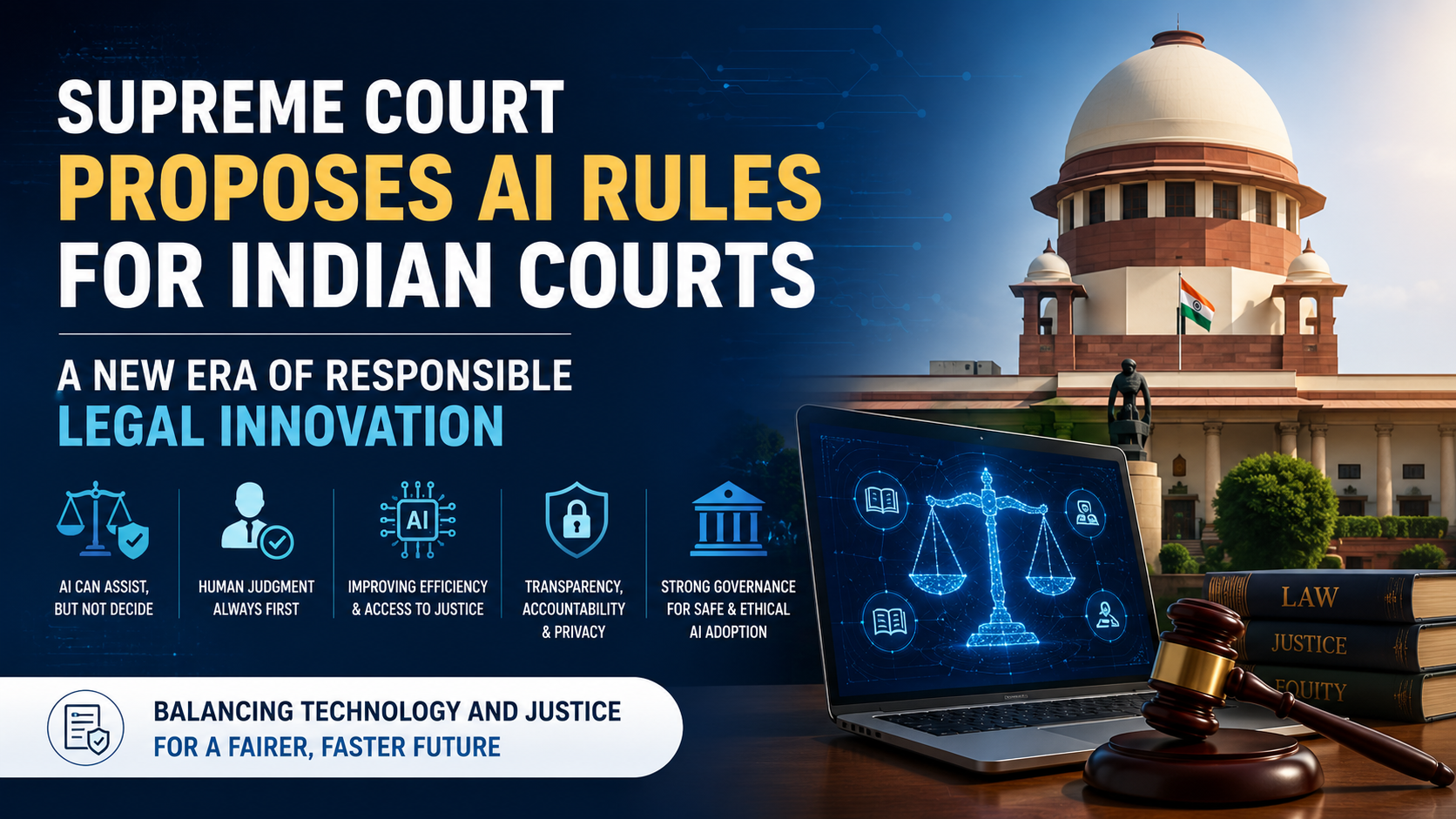
India’s Supreme Court has unveiled a landmark draft framework for the use of Artificial Intelligence (AI) in courts, marking one of the country’s most significant judicial modernisation efforts in recent years.
The proposed “Regulations for Use of Artificial Intelligence (AI) in Courts, 2026” aim to help courts benefit from AI-powered efficiency while ensuring that justice remains firmly in human hands.
As AI adoption accelerates across industries, the judiciary is now preparing for a future where technology can assist legal processes without replacing judicial decision-making.
A Clear Message: AI Can Assist, But It Cannot Judge
At the heart of the proposed regulations is a simple but powerful principle:
AI can support judges, but it cannot replace them.
The Supreme Court has emphasised that all decisions involving law, evidence, rights, liberty, and justice must remain the responsibility of human judges.
This means AI will not be allowed to:
- Decide court cases
- Determine bail eligibility
- Recommend sentences
- Assess witness credibility
- Predict criminal behaviour
- Influence judicial outcomes
The draft framework makes it clear that judicial independence and human judgement must always take precedence over algorithmic recommendations.
How AI Could Improve Court Efficiency
While the regulations prohibit AI from making legal decisions, they actively encourage its use in administrative and support functions.
Potential AI applications include:
- Legal research
- Case summarisation
- Judgement analysis
- Citation verification
- Translation services
- Court transcription
- Scheduling hearings
- Record management
- Digital document processing
- AI-powered citizen assistance chatbots
These capabilities could significantly reduce administrative workloads and help courts handle cases more efficiently.
For litigants, AI-powered support systems could improve access to legal information and simplify interactions with court services.
Tackling the Risks of AI
The Supreme Court’s framework also addresses growing concerns surrounding AI-generated content.
One major issue globally has been the use of AI tools that generate inaccurate information or even fabricate legal references.
To address this, the draft regulations propose that:
- Lawyers must disclose when AI has been used in legal filings.
- Courts can request details about the AI tools used.
- Human verification remains mandatory.
- Responsibility for errors remains with the person submitting the document.
In other words, AI may help draft legal content, but accountability stays with humans.
Transparency and Explainability Are Mandatory
The regulations take a strong position against so-called “black-box AI” systems, tools that generate outputs without explaining how decisions are made.
The Supreme Court proposes restricting the use of AI systems that cannot provide transparency, particularly in situations affecting legal rights or personal freedom.This approach reflects growing global concerns about algorithmic bias, fairness, and accountability.
The message is clear: if an AI system cannot explain its reasoning, it should not influence critical judicial processes.
Building a Governance Framework for Judicial AI
One of the most forward-thinking aspects of the proposal is the creation of a dedicated governance structure for AI in the judiciary.
The framework includes plans for:
- A national AI oversight body for courts
- Specialised AI committees
- High Court-level AI governance teams
- Regular AI audits
- Transparency reports
- Risk assessments
- Cybersecurity reviews
- Ethical impact evaluations
Before any AI tool is widely deployed, it would need to undergo technical testing, bias assessments, and compliance reviews.
This proactive approach aims to ensure that AI systems used in courts meet strict standards of reliability, fairness, and security.
Why This Matters for India
India is rapidly becoming one of the world’s leading adopters of digital technology, AI, and e-governance initiatives.
However, few countries have established comprehensive frameworks governing how AI should be used within their judicial systems.
By introducing clear rules before large-scale AI adoption occurs, India is taking a proactive approach that could serve as a model for courts worldwide.
The framework recognises two important realities:
- AI has the potential to improve efficiency, accessibility, and case management.
- Justice must remain a fundamentally human process.
The Future of AI in Indian Courts
The Supreme Court’s proposed regulations represent a thoughtful balance between innovation and constitutional safeguards. Rather than viewing AI as either a threat or a miracle solution, the framework acknowledges its strengths while clearly defining its limitations.
If adopted after public consultation, the regulations could become the foundation of India’s judicial AI ecosystem, helping courts modernise operations, reduce delays, and improve access to justice without compromising fairness, transparency, or judicial independence. As AI continues to reshape industries worldwide, India’s judiciary is signalling that technology can support justice, but it can never replace it.








%20(1)%201.webp?updatedAt=1725274383969)