Artificial Intelligence can now write emails, generate images, create videos, answer medical questions, recommend investments, and even make business decisions.
But here’s a question very few people are asking: If AI gives dangerous advice or creates fake content, who should be held responsible?
The company that built the AI?
The business using it?
Or the person who typed the prompt?
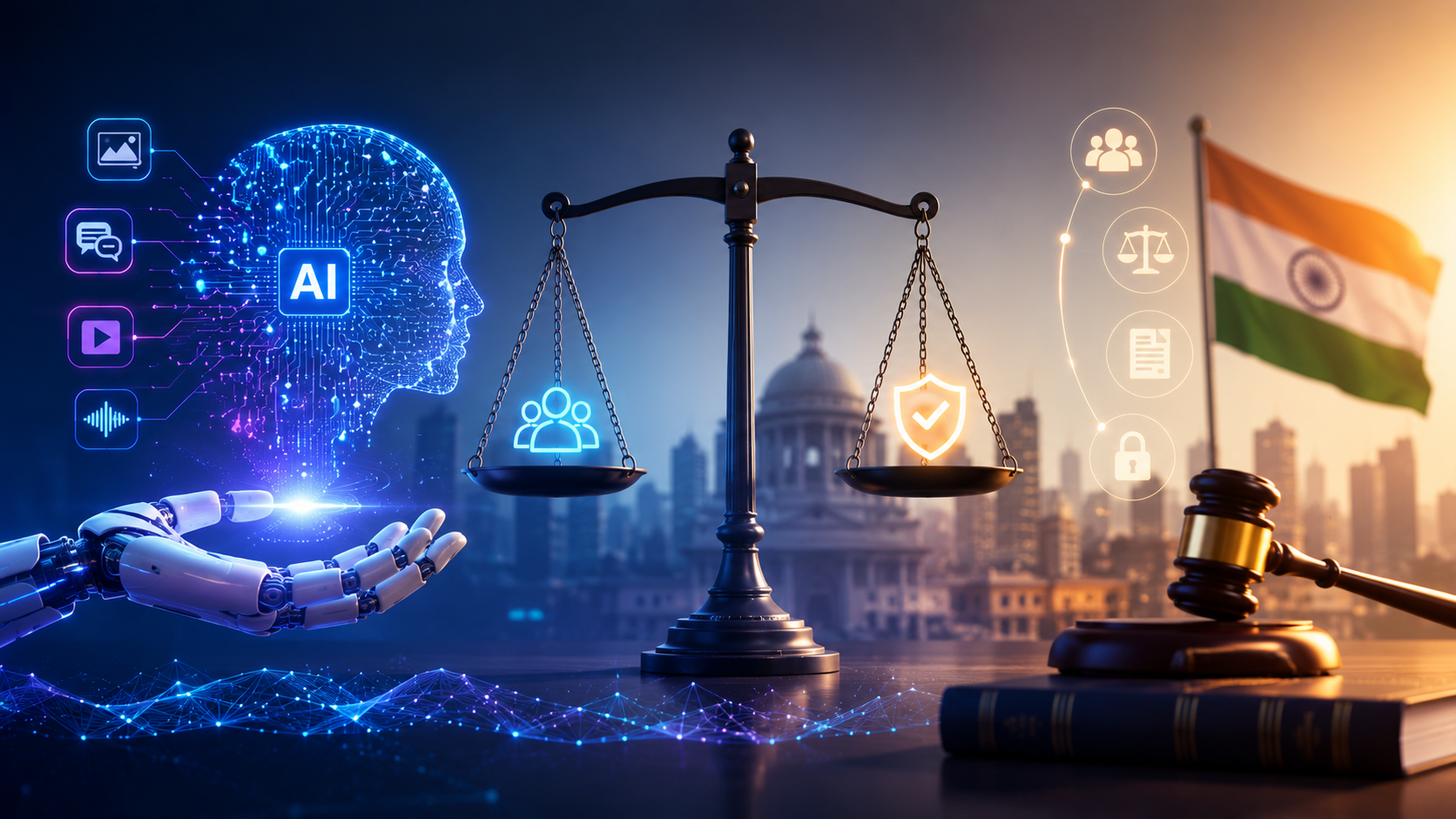
As AI becomes a bigger part of our daily lives, India is beginning to ask these important questions. One of the biggest debates revolves around something called Safe Harbour Protection, a law that helped build today’s internet but may no longer fit the age of Artificial Intelligence.
Imagine This…
Suppose someone uploads a fake video to a social media platform.
Normally, the platform didn’t create that video. A user did.
Now imagine you ask an AI chatbot to generate an image.
The AI itself creates a fake image that damages someone’s reputation.
See the difference?
One platform hosts content.
The other creates it.
That simple difference is why governments across the world are rethinking AI regulations.
What Exactly Is Safe Harbour?
Think of Safe Harbour as a legal safety shield.
It protects internet platforms from being blamed for everything their users post online.
For example:
- Facebook isn’t legally responsible for every post uploaded by billions of users.
- YouTube didn’t create every video on its platform.
- X (formerly Twitter) isn’t the author of every tweet.
In India, this protection comes from Section 79 of the Information Technology Act, 2000.
Without Safe Harbour, social media platforms would constantly face lawsuits for content they never created.
Why AI Doesn’t Fit the Same Rule
This is where things become interesting.
Traditional platforms mostly store or display information.
AI actually generates it.
Ask ChatGPT to write an article.
Ask an AI image generator to create a picture.
Ask an AI assistant to summarize legal documents.
The output didn’t previously exist.
The AI created it.
That completely changes the legal equation.
The Real Question Nobody Can Ignore
Imagine an AI recommends the wrong medicine.
Or generates fake financial advice.
Or creates a convincing deepfake.
Or wrongly rejects someone’s loan application.
Who pays for the damage?
The software company?
The business using the AI?
Or the user?
There isn’t a simple answer.
And that’s exactly what India’s policymakers are trying to solve.
India Is Building Rules Before the Problem Gets Bigger
Rather than waiting until AI becomes impossible to regulate, India is reviewing its existing technology laws.
According to recent reports, policymakers are exploring a dedicated AI framework covering areas such as:
- AI generated misinformation
- Deepfakes
- Data privacy
- Copyright
- Transparency
- AI accountability
- Human oversight
- Agentic AI
- Risk management
The objective isn’t to stop innovation.
It’s to make AI trustworthy.
Shared Responsibility Could Be the Future
Many experts believe responsibility shouldn’t fall on one company alone.
Instead, everyone in the AI ecosystem should play a role.
AI Developers
- Build reliable and transparent systems.
Businesses
- Deploy AI responsibly and monitor outcomes.
Users
- Use AI ethically and verify important information.
This shared responsibility model is already becoming the preferred approach in several countries.
Why Businesses Should Pay Attention
For companies using AI, future regulations may require:
- Better documentation
- AI audits
- Human approval for critical decisions
- Transparent AI policies
- Risk assessments
- Explainable AI systems
Businesses that build governance into their AI strategy today will likely have an advantage tomorrow.
Compliance is quickly becoming a competitive advantage.
What This Means for India’s AI Future
India is positioning itself as one of the world’s fastest-growing AI economies.
The country wants innovation.
But it also wants accountability.
Finding the right balance between these two goals will determine how confidently businesses, governments, and citizens adopt AI over the next decade.
The Safe Harbour debate is therefore much bigger than a legal discussion.
It is about deciding how humans and AI will work together in the future.
Preparing Your Business for the Next Era of AI
As governments around the world introduce new AI regulations, one thing is becoming clear: businesses can no longer afford to treat AI as just another software tool. Transparency, governance, security, human oversight, and compliance are quickly becoming essential parts of every AI strategy.
Whether you’re planning to build an AI-powered SaaS platform, an intelligent chatbot, workflow automation system, or a custom AI application, building it the right way from the beginning will save significant time, cost, and compliance challenges in the future.
At Kriscent, we’ve spent more than a decade helping businesses build secure, scalable, and future-ready digital products. Today, we help organizations adopt AI responsibly through custom AI development, workflow automation, AI agents, enterprise integrations, and intelligent business solutions designed for long-term growth.
Planning an AI product or automation project?
Book a free AI strategy consultation with Kriscent and discover how to build AI solutions that are innovative, scalable, and ready for tomorrow’s regulatory landscape.
<Schedule Your Free Consultation>
Final Thoughts
Artificial Intelligence is no longer just a tool that answers questions.
It is beginning to make decisions, create content, and influence millions of people every day.
As AI becomes more powerful, the rules governing it must evolve too.
India’s review of Safe Harbour laws signals an important shift: the future of AI will not only depend on technological breakthroughs but also on building systems that are transparent, accountable, and worthy of public trust.






%20(1)%201.webp?updatedAt=1725274383969)