
Running a business has never been just about having a good product or service.
A business owner may be excellent at coaching, consulting, training, manufacturing, providing a professional service or solving a particular customer problem. But as the business grows, something interesting happens.
The owner gradually starts spending less time on the work they are actually good at and more time managing everything around it.
- Customer enquiries need replies.
- Leads need follow-ups.
- Marketing needs attention.
- Social media needs content.
- Sales conversations need to happen.
- Appointments need to be managed.
- Customers need updates.
- Payments need reminders.
- Teams need information.
- Reports need to be checked.
Individually, these may seem like small tasks. Together, they can consume a significant part of the working day.
This is where AI, automation and better business systems are beginning to change how businesses operate.
And contrary to popular belief, you don’t necessarily need to be a programmer or technology expert to benefit from them.
The Real Problem Isn’t Always Lack of Growth
When a business isn’t growing as expected, the natural reaction is often:
“Humein aur customers chahiye.”
Sometimes that’s absolutely true.
But sometimes the deeper problem lies somewhere else.
- Perhaps enquiries are coming in, but responses are delayed.
- Perhaps people show interest, but nobody follows up consistently.
- Perhaps money is being spent on marketing without properly tracking what happens afterwards.
- Perhaps the owner is involved in so many routine activities that there is very little time left for strategy and growth.
- Or perhaps the business has grown, but the way it operates hasn’t.
This creates an important distinction:
Growing a business isn’t only about doing more.
It’s also about building a better way of doing what you already do.
What Does a “Smarter Business” Actually Look Like?
The phrase business automation can sound complicated.
In reality, the idea behind it is quite simple.
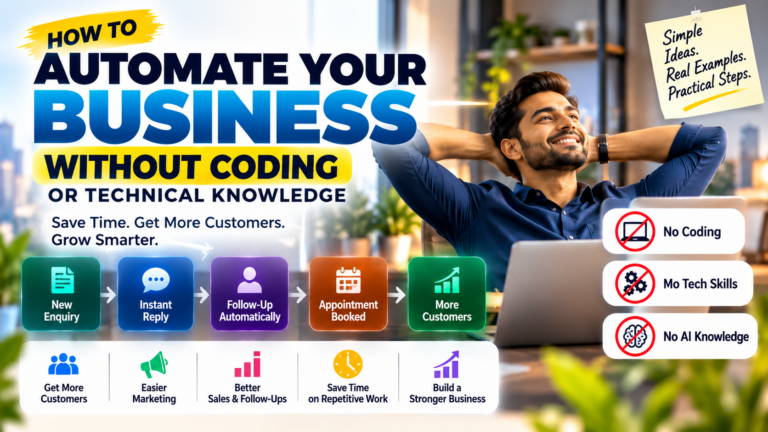
Imagine someone enquires about your service.
Instead of waiting several hours for someone to notice the message, they receive a timely response.
If they are interested but aren’t ready to buy immediately, the follow-up isn’t forgotten.
If they want a meeting, the process of scheduling it becomes easier.
If an existing customer needs a reminder, the business doesn’t depend on someone remembering it manually.
Customer information remains organised.
The owner can understand what is happening without asking five different people.
Marketing becomes more consistent.
Routine work becomes easier to manage.
That’s what a better system looks like.
Technology is simply what makes many of these systems easier to build today.
Upcoming Live Webinar
📅 October 3, Saturday
⏰ 7:15 PM IST
💻 Live Online Session
If you’d like to attend, you can register below.
[REGISTER FOR THE LIVE WEBINAR]
Bring your own business problems with you.
That will make the session considerably more useful than simply learning about another collection of tools.
Where Does AI Fit Into All of This?
Artificial Intelligence has attracted enormous attention, but much of the conversation focuses on individual tools.
A more useful question for a business owner isn’t:
“Which AI tool should I use?”
It is:
“Which problem in my business can AI help me solve?”
That small change in thinking is important.
A business doesn’t need AI simply because AI is popular.
It needs solutions to real problems.
AI may help create content faster.
- It may help answer common customer questions.
- It may assist with analysing information.
- It may make repetitive communication easier.
- It may help a team prepare marketing material.
- It may support sales and follow-up processes.
- It may help organise information that previously required significant manual effort.
The objective isn’t to put AI everywhere.
The objective is to use it where it genuinely saves time or improves the way work gets done.
Start With the Customer, Not the Technology
One of the easiest mistakes businesses make is starting with tools. A better starting point is the customer journey.
Think about what happens from the moment someone first discovers your business.
Stranger → Interested Person → Enquiry → Conversation → Customer → Repeat Customer
Now ask a few simple questions.
- Where are people dropping out?
- How quickly are enquiries answered?
- Does every interested person receive a follow-up?
- Does your team know which customers require attention?
- Is there a clear sales process?
- What happens after someone becomes a customer?
- Are previous customers ever contacted again?
These questions often reveal more opportunities than simply installing another piece of software.
Marketing Should Create More Than Likes
Another area where businesses can benefit from better systems is marketing.
It is easy to confuse marketing activity with marketing results.
Posting every day is activity.
Making reels is activity.
Running advertisements is activity.
Getting views is activity.
But the purpose of business marketing should ultimately be to move people through a journey:
Attention → Interest → Trust → Enquiry → Customer
That means the question shouldn’t only be:
“Aaj social media par kya post karein?”
It should also be:
“Hum jis person tak pahunch rahe hain, usko next step lene ka reason kya de rahe hain?”
AI can make content creation faster, but strategy still matters.
Technology can help you produce more.
It cannot automatically make an unclear business proposition valuable.
Sales Often Breaks After the Lead Arrives
Businesses spend considerable effort trying to generate leads.
But what happens after the lead arrives can be equally important.
Consider a simple situation.
A potential customer sees an advertisement and sends an enquiry.
They receive a response.
They ask a few questions.
Then they say:
“Main soch kar batata hoon.”
What happens next?
In many businesses, nothing.
The salesperson gets busy. Another enquiry arrives. A day passes. Then three days.
The interested customer eventually disappears.
Better systems help reduce this dependency on memory.
They can make it easier to know:
- Who needs a reply?
- Who needs a follow-up?
- Who is interested?
- Who booked a meeting?
- Who became a customer?
- Who didn’t?
This is where technology starts having a measurable purpose.
Automation Isn’t About Removing People
There is another misconception worth addressing.
Automation does not necessarily mean removing humans from the business.
A better way to think about it is:
Let people do the work that needs people.
- A coach should spend more time coaching.
- A consultant should spend more time solving client problems.
- A trainer should spend more time training.
- A business owner should spend more time making decisions, building relationships and finding opportunities.
If someone is repeatedly copying the same information, sending the same reminder, checking the same spreadsheet or performing another predictable task, that’s where a better process may help.
The purpose is not:
Human OR Technology.
The more useful approach is:
Human + Technology.
Before Automating Anything, Ask These 5 Questions
Before looking for software, AI or automation, write down the answers to these questions:
- Which tasks do we repeat every day or every week?
- Where do customers have to wait unnecessarily?
- Where do leads or sales opportunities get lost?
- Which activities consume a lot of time but require very little decision-making?
- Which parts of the business stop working when one particular person is unavailable?
The answers give you a much better starting point.
You may discover that you don’t need ten new tools.
You may only need to improve two or three important processes.
The Goal Is Not a Fully Automated Business
It can be tempting to imagine a business where everything happens automatically.
But that shouldn’t necessarily be the goal.
Customers still value human relationships.
Important decisions still require judgment.
Sales conversations may require empathy.
Leadership requires people.
Creative ideas require context.
Complex problems require experience.
So the better objective is:
Automate the predictable. Simplify the repetitive. Keep humans where humans matter.
That creates a much healthier balance.
The Bigger Shift: From Operator to Business Builder
For many entrepreneurs, the biggest transformation isn’t adopting AI.
It’s changing how they think about their own role.
In the beginning, doing everything yourself is often necessary.
- You find customers.
- You make the sale.
- You deliver the work.
- You collect the payment.
- You solve the problem.
But if the business grows and the same model continues forever, the owner eventually becomes the bottleneck.
A useful question is:
“If I disappeared from my business for 10 days, what would stop working?”
The answer tells you where systems are missing.
The long-term objective is not to become unnecessary to your business.
It is to become valuable for the right reasons.
Your business should need your judgment, vision and leadership.
It shouldn’t need you to remember every follow-up.
Mindset Still Matters
There is a reason conversations about business growth cannot be limited to technology.
Two people can have access to exactly the same tools and achieve completely different results.
Why?
Because tools don’t decide whether you take action.
They don’t decide whether you understand your customer.
They don’t decide whether your offer solves a meaningful problem.
They don’t decide whether you consistently execute.
They don’t decide how you respond when something fails.
Technology can amplify a good process.
But it cannot replace clear thinking.
This is why sustainable business growth usually involves three areas working together:
Mindset
How you think, decide, adapt and execute.
Customers
How you attract, communicate with, convert and retain people.
Systems
How consistently the business performs its important activities.
When these three areas improve together, technology becomes far more useful.
Upcoming Live Webinar
📅 October 3, Saturday
⏰ 7:15 PM IST
💻 Live Online Session
If you’d like to attend, you can register below.
[REGISTER FOR THE LIVE WEBINAR]
Bring your own business problems with you.
That will make the session considerably more useful than simply learning about another collection of tools.
You Don’t Need to Become a Technology Expert
For many business owners, AI still feels intimidating.
There are new tools every week.
New terminology.
New platforms.
New promises.
Trying to learn everything is unnecessary.
A restaurant owner doesn’t need to understand how payment-processing infrastructure works to accept a digital payment.
Similarly, a business owner doesn’t need to understand every technical detail behind AI to identify where it can be useful.
The more practical skill is knowing:
What problem am I trying to solve?
What part can technology handle?
What should remain human?
How will I know whether the new process is actually better?
Those questions are far more valuable than memorising hundreds of AI tools.
Start With One Problem
If all of this feels overwhelming, don’t try to transform the entire business at once.
Choose one problem.
Maybe customer enquiries aren’t answered quickly enough.
Maybe follow-ups are inconsistent.
Maybe marketing takes too much time.
Maybe appointments are difficult to manage.
Maybe customer information is scattered everywhere.
Maybe you don’t know which leads are actually worth pursuing.
Solve one meaningful problem.
Measure the difference.
Then move to the next.
Smart businesses are rarely built overnight.
They are built one better process at a time.
Want to Explore This Practically?
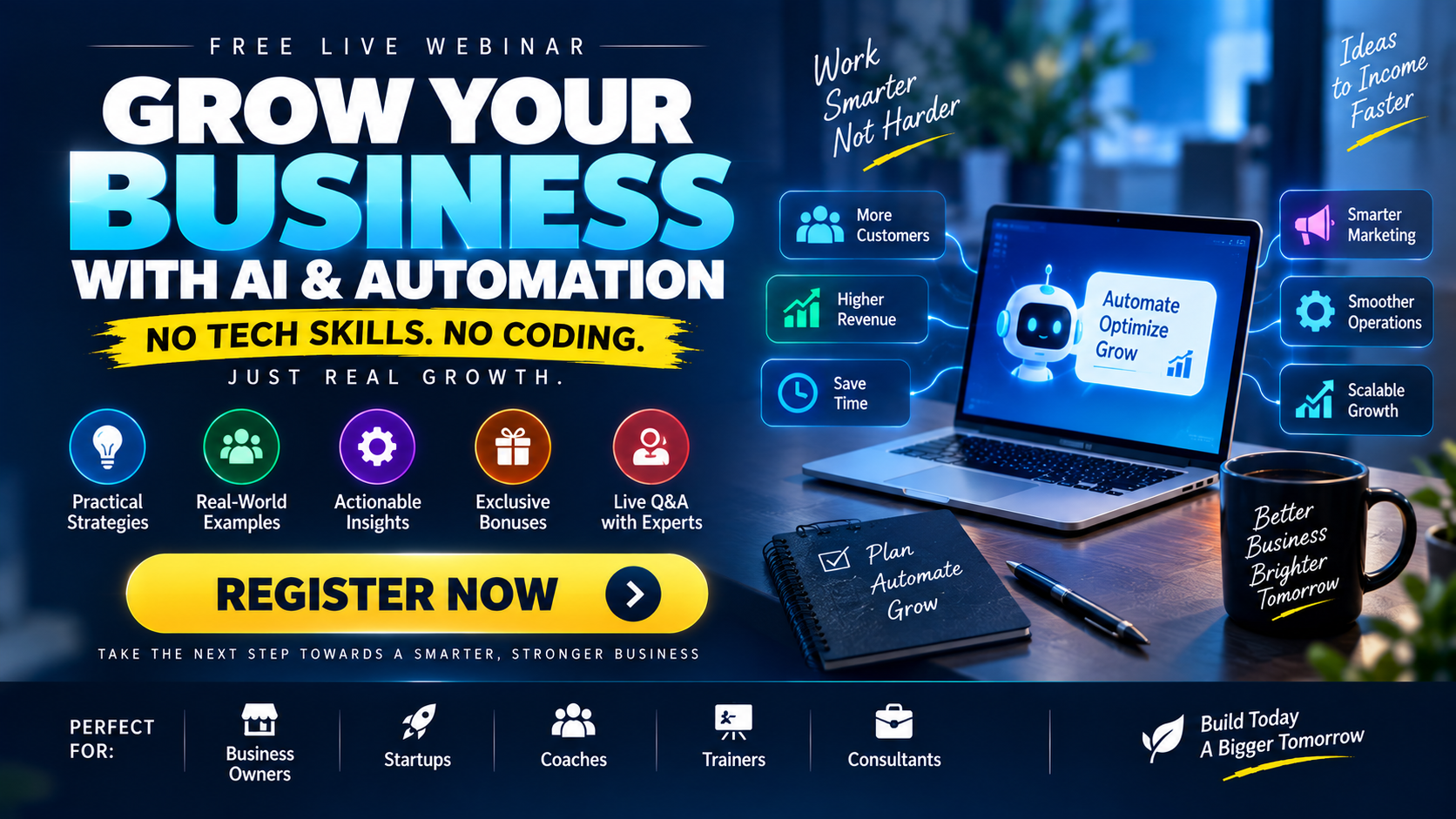
If these ideas made you look differently at your own business, we explore them in much greater depth during our AI Wealth & Business Accelerator Live Webinar.
The webinar is designed for business owners, startup founders, coaches, trainers, consultants and other professionals who want to understand how AI, automation, marketing, sales and better systems can be applied to real business situations.
You do not need coding knowledge or previous AI experience.
The objective is not to turn you into a technology expert.
It is to help you understand what is possible and identify where these ideas may be useful in your own business.
Upcoming Live Webinar
📅 October 3, Saturday
⏰ 7:15 PM IST
💻 Live Online Session
If you’d like to attend, you can register below.
[REGISTER FOR THE LIVE WEBINAR]
Bring your own business problems with you.
That will make the session considerably more useful than simply learning about another collection of tools.

%20(1)%201.webp?updatedAt=1725274383969)