
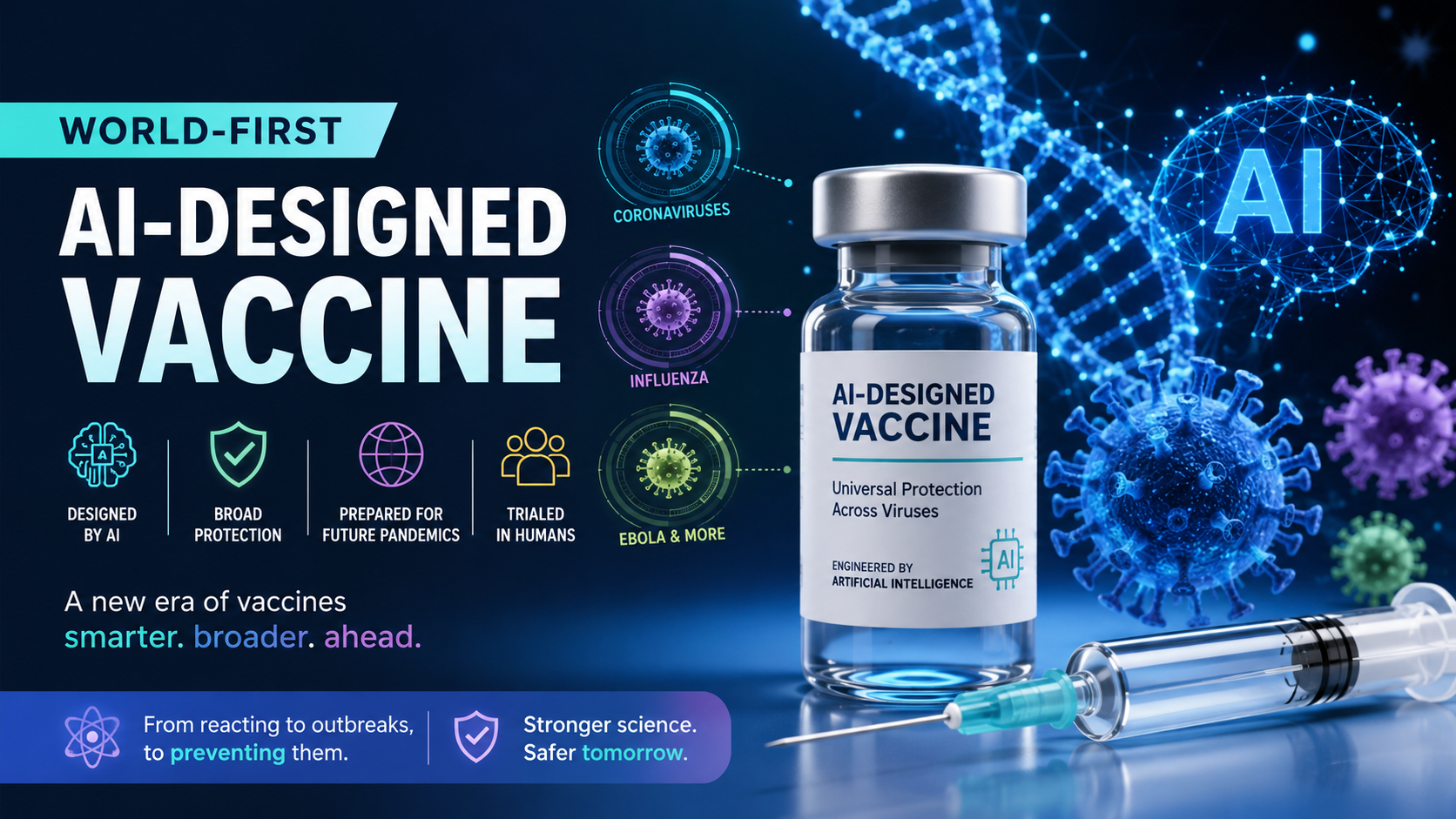
In a breakthrough that could reshape the future of global healthcare, researchers at the University of Cambridge have successfully developed and tested what is being described as the world’s first AI-designed vaccine component in human trials.
The experimental vaccine uses Artificial Intelligence to create a “super-antigen” capable of protecting against entire families of viruses rather than a single strain. Scientists believe this approach could eventually help prevent future pandemics by providing broader and longer-lasting protection against rapidly evolving viruses.
A New Era of Vaccine Development
Traditional vaccines are typically designed to target a specific virus strain. However, viruses such as COVID-19 and influenza constantly mutate, making vaccines less effective over time and requiring regular updates.
Researchers at Cambridge are taking a fundamentally different approach.
Instead of focusing on one existing virus, scientists used AI to analyse genetic information from multiple coronaviruses collected through global disease surveillance programs. The AI then designed a universal antigen capable of training the immune system to recognise and respond to a much wider range of coronavirus threats.
This includes:
- Existing COVID-19 variants
- Future coronavirus mutations
- Animal viruses that could potentially jump to humans
- Emerging viral threats with pandemic potential
The goal is simple: move from reacting to outbreaks to preparing for them before they happen.
What Makes This Vaccine Different?
At the heart of every vaccine is an antigen, the component that teaches the immune system what to attack.
For the first time, researchers used Artificial Intelligence to design this critical vaccine component entirely from scratch. The AI-generated “super-antigen” was engineered to provide broad protection against multiple related viruses rather than a single known strain.
Professor Jonathan Heeney of the University of Cambridge described the development as a major shift in pandemic preparedness.
According to Heeney, scientists are trying to move beyond the cycle of constantly updating vaccines after new variants emerge and instead develop vaccines capable of protecting against future outbreaks before they occur.
Human Trials Show Early Promise
The first phase of human testing involved 39 volunteers and was primarily designed to evaluate safety. Results published in the Journal of Infection indicate that the vaccine generated a measurable immune response while maintaining a strong safety profile.
Although researchers described the immune response as modest at this stage, experts remain optimistic about the technology’s long-term potential. A second study involving approximately 200 participants is now underway to better understand how effectively the vaccine can train the immune system.
Beyond COVID: Flu, Bird Flu and Ebola
The technology’s potential extends far beyond coronaviruses.
Researchers are already working on AI-designed vaccines targeting:
- Seasonal influenza
- H5N1 bird flu
- Viral haemorrhagic fevers
- Ebola-related diseases
One of the most promising applications could be the development of a universal flu vaccine that eliminates the need for annual reformulations. Scientists also believe the technology could accelerate vaccine development during future health emergencies by dramatically reducing research timelines.
Why AI Could Be a Game-Changer for Healthcare
Artificial Intelligence is increasingly being used across healthcare for diagnostics, drug discovery, medical imaging, and personalised medicine.
Vaccine development may be the next major frontier.
AI systems can process vast amounts of biological data far faster than traditional research methods, identifying patterns and opportunities that may take human researchers years to discover.
Experts believe AI could help:
- Predict viral evolution
- Design more effective vaccines
- Accelerate clinical research
- Improve pandemic preparedness
- Reduce vaccine development timelines
Professor Andy Pollard, Director of the Oxford Vaccine Group, described the findings as fascinating and noted that AI has the potential to transform how scientists develop vaccines in the future.
A Step Toward Pandemic Prevention
While the research is still in its early stages, scientists believe the results represent a significant milestone in the evolution of vaccine technology.
Rather than continuously chasing new viral variants, AI-designed vaccines could eventually provide broad protection against entire virus families, helping humanity stay ahead of future outbreaks.
As artificial intelligence continues to reshape industries worldwide, its growing role in healthcare may prove to be one of its most impactful applications, potentially saving millions of lives and transforming how the world prepares for future pandemics.







%20(1)%201.webp?updatedAt=1725274383969)