
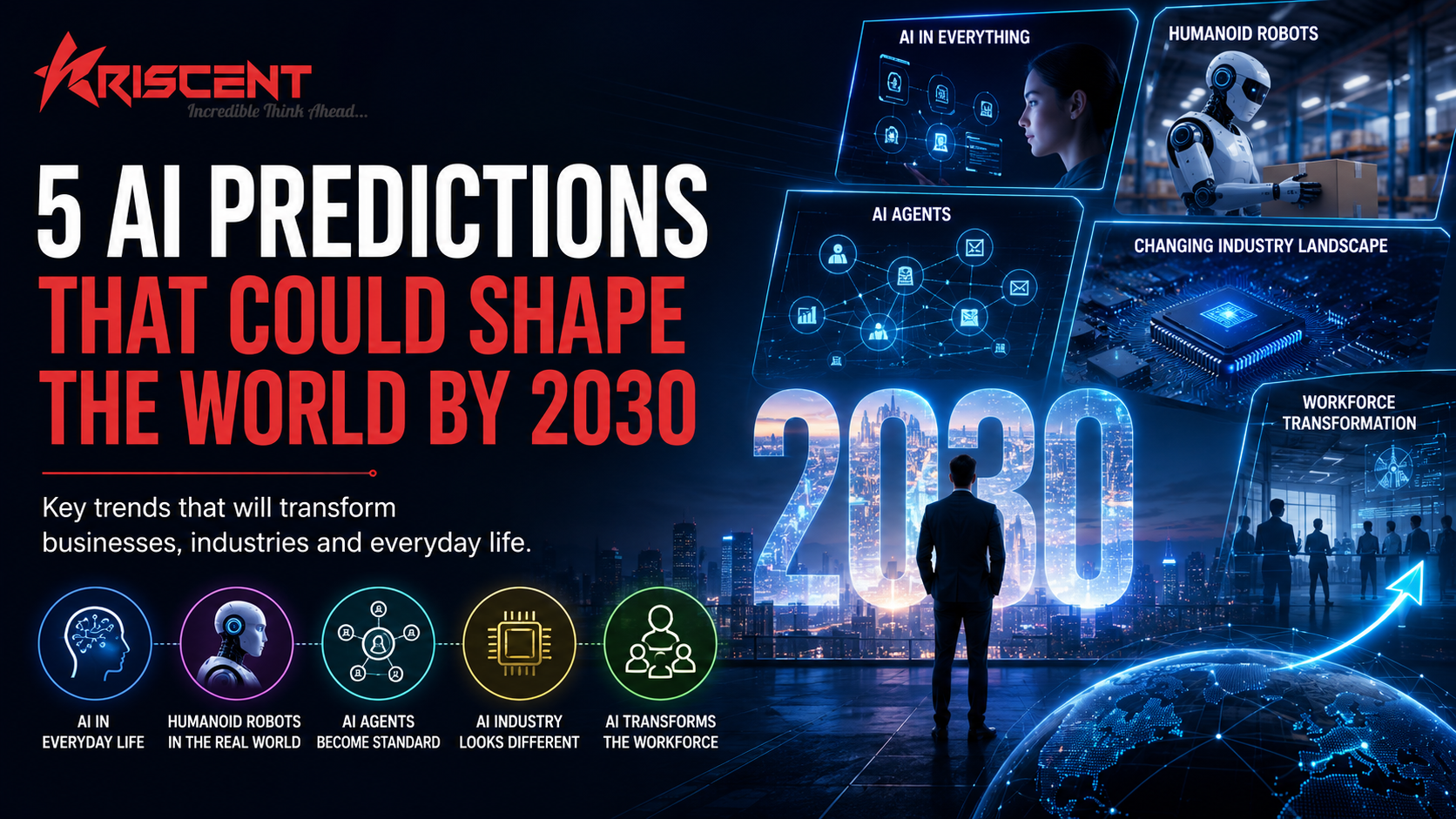
Artificial intelligence is evolving faster than most experts expected. While today’s AI revolution is focused on chatbots, content generation, and automation, the next five years could completely redefine how businesses, economies, and people interact with technology.
According to AI investor and industry analyst Rob Toews, several major shifts are likely to emerge by 2030. Here are the key predictions reshaped for business leaders and technology enthusiasts.
1. AI Will Become Part of Everyday Life
By 2030, AI may move far beyond simple assistants and become deeply integrated into daily activities. From personal productivity and education to customer support and business operations, AI systems are expected to work alongside humans in ways that feel natural and seamless.
Instead of opening a chatbot when needed, people may interact with AI continuously throughout their day.
2. Humanoid Robots Will Enter the Real World
The next wave of AI is expected to move from software into the physical world.
Advances in robotics and machine intelligence could lead to large-scale deployment of humanoid robots in warehouses, factories, logistics centers, healthcare facilities, and service industries. These robots may perform tasks that currently require human labor while operating with increasing autonomy.
3. AI Agents Will Become Standard
Today’s discussion around “AI agents” may eventually disappear, not because the technology failed, but because it became the norm.
Future AI systems are expected to plan, execute tasks, make decisions, and achieve goals with minimal human intervention. As these capabilities become standard features, the term “AI agent” may no longer feel special or distinct.
4. The AI Industry Will Look Very Different
The dominance of today’s AI infrastructure leaders may not remain unchanged.
As demand for AI computing grows, new competitors, custom chips, and alternative hardware providers are expected to emerge. The AI ecosystem could become more diverse, reducing dependence on a small number of companies and creating new opportunities across the semiconductor and infrastructure sectors.
5. AI Will Transform the Workforce
Perhaps the most debated prediction is AI’s impact on jobs.
Many routine and repetitive tasks across industries could become automated, increasing productivity and reducing operational costs. At the same time, entirely new roles, industries, and business models are likely to emerge.
The challenge for governments, businesses, and professionals will be adapting quickly enough to stay relevant in an AI-driven economy. Discussions around workforce reskilling, digital education, and future employment models are expected to intensify throughout the decade.
Final Thoughts
Whether every prediction becomes reality remains to be seen. However, one thing is clear: AI is no longer just a technology trend. It is rapidly becoming a foundational layer of the global economy.
The businesses that invest in AI readiness, digital infrastructure, automation, and workforce transformation today will be better positioned to lead in the decade ahead.
Source: Forbes – Rob Toews’ analysis on AI trends and predictions for 2030.

%20(1)%201.webp?updatedAt=1725274383969)