
A New AI Breakthrough Could Make Heart Disease Diagnosis Faster, Safer, and More Accurate
Imagine visiting a cardiologist with chest pain and getting a reliable assessment of blocked heart arteries in under a minute, without additional invasive procedures.
That future may be closer than we think.
Researchers have unveiled a new Artificial Intelligence powered technology capable of analyzing heart scans in just 36 seconds, helping doctors identify dangerous coronary artery blockages with remarkable accuracy. The innovation has the potential to simplify one of cardiology’s most important diagnostic procedures and improve patient care worldwide.
Why Heart Blockages Matter
Heart disease remains one of the leading causes of death globally. One of the biggest challenges doctors face is determining whether a narrowed artery is actually restricting blood flow enough to require treatment.
Today, this often requires an invasive procedure where a pressure wire is inserted into the coronary artery. While highly effective, the process takes additional time, increases procedural complexity, and may not always be available in every hospital.
What if AI could provide nearly the same answer using images doctors are already capturing?
That is exactly what researchers set out to achieve.
Meet AI-FFR: Artificial Intelligence for Heart Diagnosis
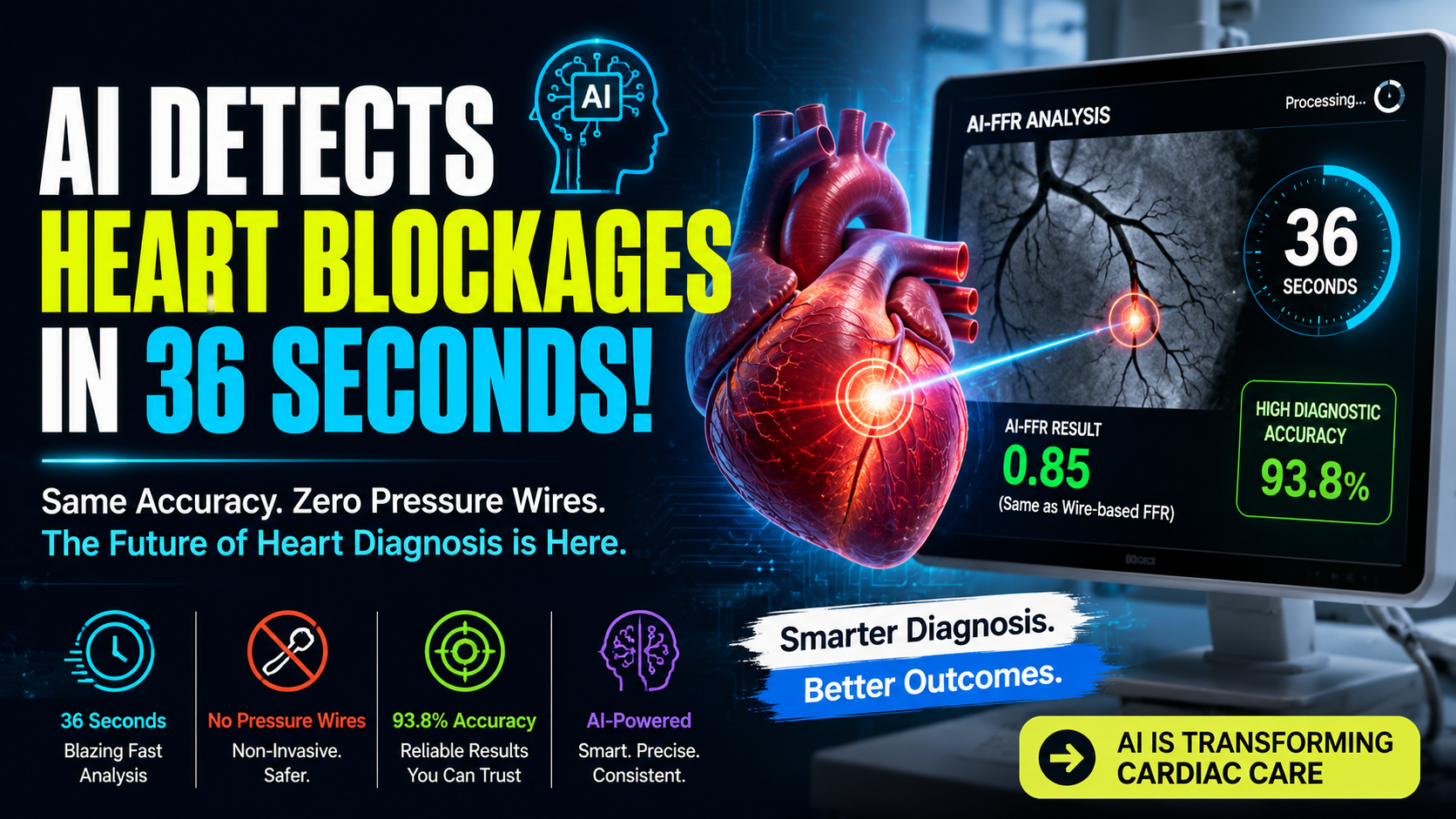
The new technology, called AI-FFR, analyzes standard coronary angiography images using machine learning.
Instead of requiring pressure wires or additional medications, the software studies the blood vessels and estimates how well blood is flowing through the heart.
Even more impressive, the system completed its analysis in an average of 36 seconds.
For nearly 74% of patients, the software automatically identified the affected artery without any manual assistance from doctors.
Accuracy That Rivals Traditional Methods
The results were highly encouraging.
Researchers compared the AI system with the current gold standard invasive test and found that both produced the same average measurement.
The AI also demonstrated:
- 90.2% sensitivity, meaning it successfully identified most patients with significant blockages.
- 94.9% specificity, reducing false alarms.
- 93.8% overall diagnostic accuracy, making it one of the most promising AI tools currently under evaluation for cardiovascular imaging.
The technology even performed well in difficult “gray zone” cases where traditional diagnosis is often more challenging.
Why This Matters for Patients
If future clinical trials confirm these findings, AI-assisted diagnosis could offer several important benefits:
- Faster diagnosis during heart procedures
- Reduced dependence on invasive pressure wires
- Lower procedural costs
- More consistent evaluations between hospitals
- Improved access to advanced cardiac care, especially in regions with limited resources
Ultimately, this could mean quicker treatment decisions and better outcomes for patients.
AI Is Becoming a Silent Partner for Doctors
Contrary to popular belief, AI is not replacing physicians.
Instead, it is becoming a powerful clinical assistant that helps doctors analyze complex medical data faster and with greater consistency.
Whether it is detecting cancer, identifying strokes, predicting disease risk, or now assessing blocked heart arteries, AI is steadily transforming healthcare into a more precise, data-driven field.
The Road Ahead
The researchers acknowledge that this study was retrospective and that additional prospective clinical trials are still needed before the technology becomes routine in hospitals.
However, the early results are promising.
As AI continues to mature, innovations like AI-FFR demonstrate how intelligent software can reduce complexity, accelerate diagnosis, and support better clinical decisions without replacing the expertise of medical professionals.
The future of healthcare may not simply be digital.
It may be AI-assisted, faster, and more accessible for everyone.






%20(1)%201.webp?updatedAt=1725274383969)