
Artificial intelligence is becoming an everyday companion for millions of professionals, students, creators, and businesses. But while AI tools are becoming more powerful, a growing question remains: Are we using AI effectively, or simply using it more often?
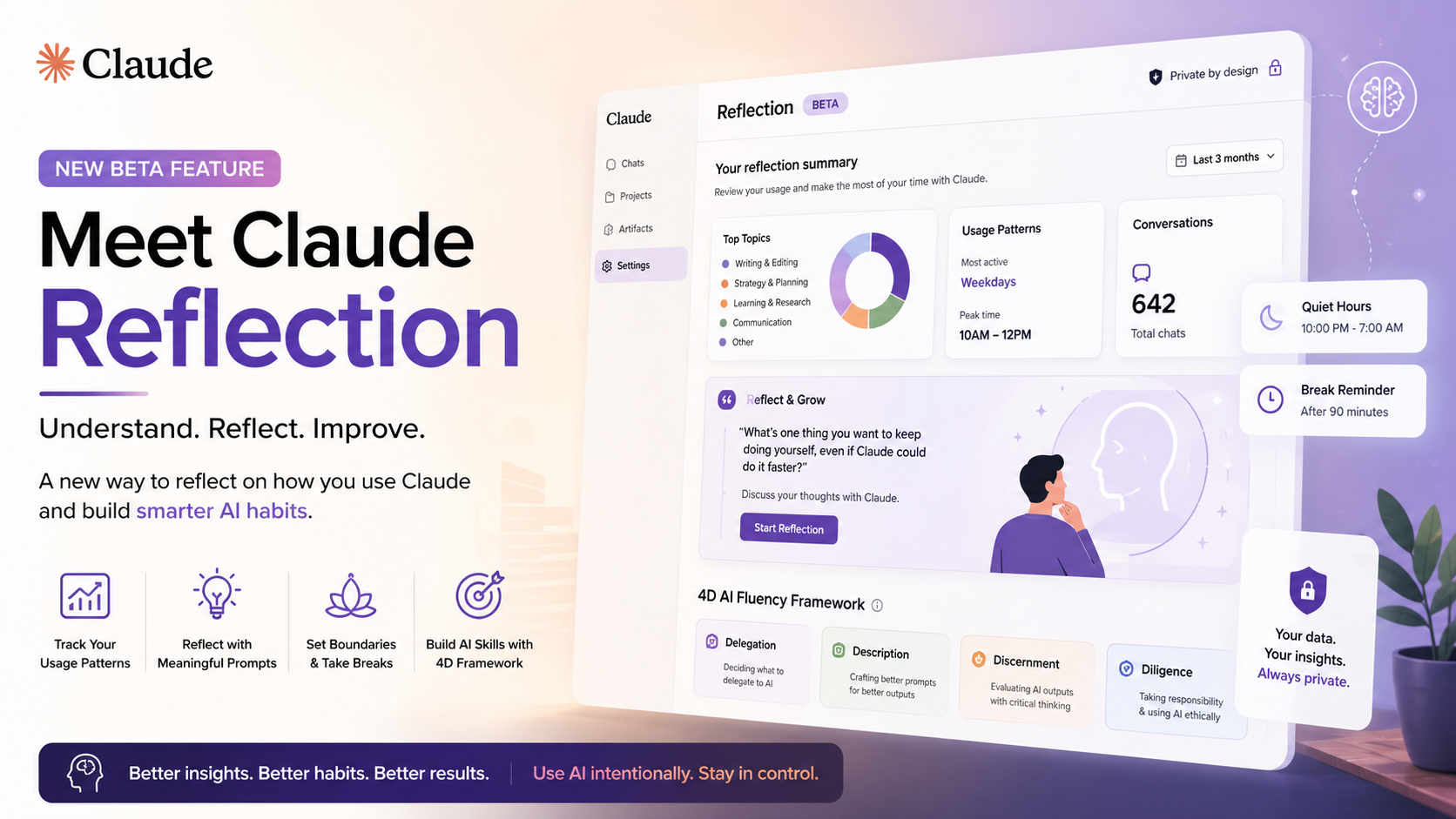
Anthropic is addressing that question with the launch of Claude Reflection, a new beta feature that helps users analyze, understand, and improve the way they interact with Claude AI.
Rather than adding another AI capability, this update focuses on something equally important: helping people build healthier, smarter, and more intentional AI habits.
What Is Claude Reflection?
Claude Reflection is a personalized dashboard that provides users with insights into how they use Claude over time. Available through Claude’s web and desktop applications, the feature summarizes conversations, highlights usage trends, and encourages users to think critically about how AI fits into their daily workflow.
Instead of measuring productivity only by time spent, Claude Reflection aims to improve the quality of AI collaboration.
Users can review their activity across the past 1, 3, 6, or 12 months, making it easier to identify patterns, recurring projects, and opportunities to optimize their workflow.
|

Key Features of Claude Reflection
AI Usage Analytics
The dashboard provides a clear overview of:
- Frequently discussed topics
- Common task categories
- Daily and weekly usage patterns
- AI interaction trends over time
Future updates will also display the total amount of time users spend working with Claude.
Personalized Reflection Prompts
One of the most unique aspects of the feature is its focus on mindful AI usage.
Instead of simply displaying statistics, Claude periodically asks thoughtful questions such as:
“What’s one thing you want to keep doing yourself, even if Claude could do it faster?”
These prompts encourage users to maintain creativity, independent thinking, and personal decision making while benefiting from AI assistance.
AI Wellness Features
Claude Reflection also introduces digital wellbeing tools, including:
- Quiet Hours to limit AI usage during selected periods
- Break reminders after extended AI sessions
- Personalized usage nudges based on user preferences
These features promote a healthier relationship with AI instead of encouraging endless engagement.
The 4D AI Fluency Framework
A standout addition is Anthropic’s 4D AI Fluency Framework, designed to help users develop stronger AI collaboration skills.
The framework evaluates AI usage across four key dimensions:
Delegation
Understanding which tasks should be assigned to AI and which require human judgment.
Description
Learning how to write better prompts that generate more accurate and useful responses.
Discernment
Evaluating AI-generated outputs critically rather than accepting them without verification.
Diligence
Taking ownership of decisions made using AI and ensuring responsible use.
The dashboard also offers personalized recommendations based on individual usage patterns. For example, it may suggest creating Projects to organize ongoing work instead of repeatedly providing the same context.
Strong Focus on Privacy
Anthropic has emphasized that privacy remains central to Claude Reflection.
The feature does not analyze:
- Incognito chats
- Connected files and source documents
- Health-related conversations linked through integrations
Only high-level summaries are used to generate personal insights, and the information remains private to the user.
To strengthen the feature’s approach to digital wellbeing, Anthropic collaborated with experts from organizations including the MIT Media Lab’s Advancing Humans with AI (AHA) Program, Digital Wellness Lab at Boston Children’s Hospital, and the Family Online Safety Institute.
Why This Matters
Most AI companies compete by introducing larger models, faster responses, or new multimodal capabilities.
Claude Reflection represents a different direction.
Instead of asking users to spend more time with AI, it encourages them to spend better time with AI.
As AI becomes deeply integrated into education, software development, marketing, business operations, and personal productivity, understanding how we collaborate with these systems may become just as valuable as the technology itself.
This shift highlights an emerging trend where AI platforms focus not only on intelligence but also on responsible adoption, digital wellbeing, and long-term productivity.
Final Thoughts
Claude Reflection signals an important evolution in the AI landscape. It transforms AI from being just a powerful assistant into a tool that also helps users evaluate and improve their own working habits.
As businesses and professionals increasingly rely on AI for strategic decisions, content creation, software development, and customer engagement, features like Claude Reflection could set a new benchmark for responsible AI usage.
The future of artificial intelligence may not simply be about building smarter models. It may be about helping people become smarter AI users.






%20(1)%201.webp?updatedAt=1725274383969)