
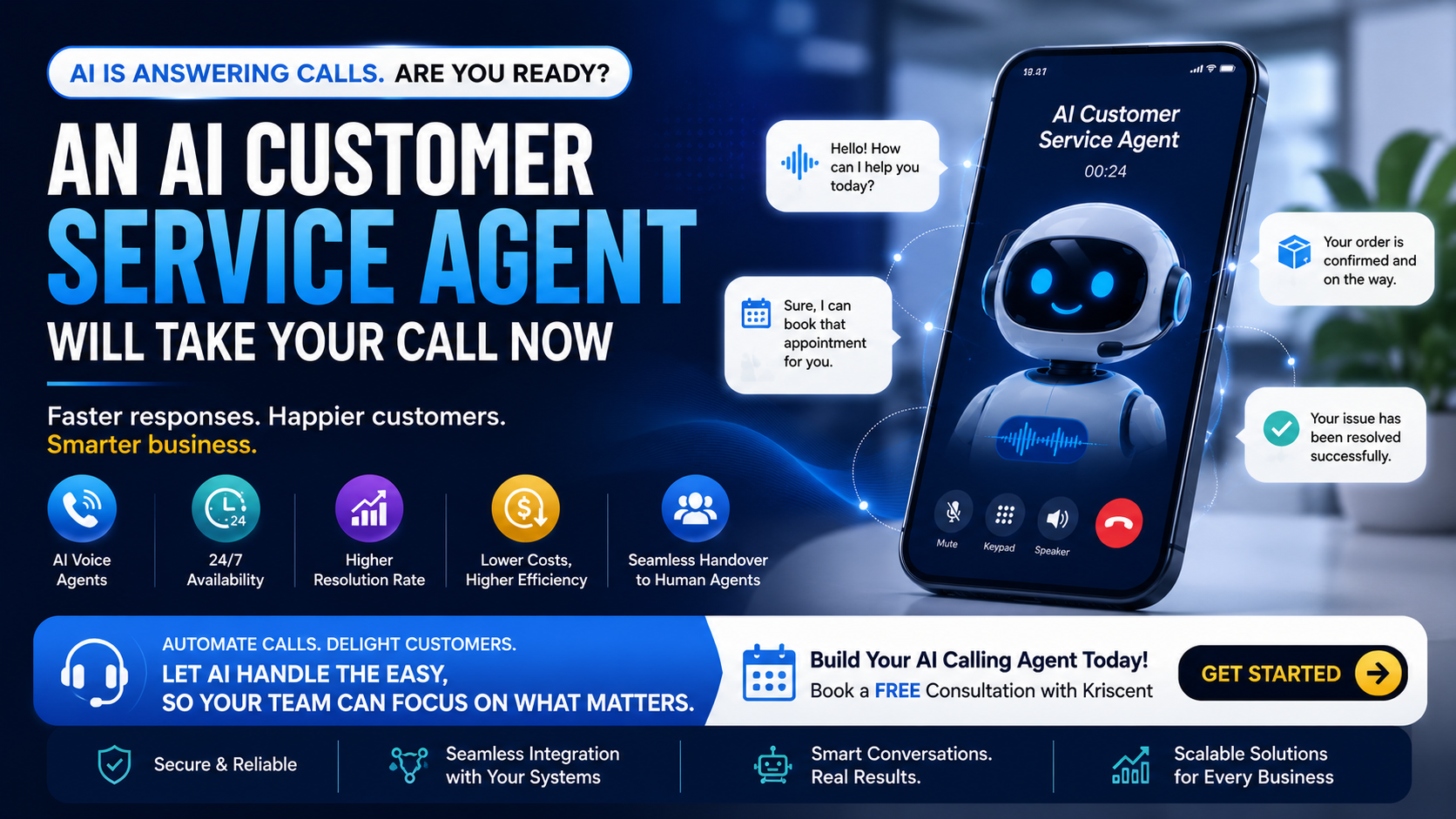
For years, businesses have promised customers faster support.
Press 1 for sales.
Press 2 for support.
Enter your customer ID.
Repeat your problem.
Wait for an agent.
Now, AI is changing that entire experience.
Businesses are increasingly experimenting with AI customer service agents that can answer calls, understand conversations, retrieve information, handle routine requests and potentially resolve issues without a human representative.
The big question isn’t whether AI can answer a phone call.
The real question is whether it can make customer service less frustrating.
And that distinction matters.
Why Are Businesses Turning to AI Customer Service?
Customer service is expensive.
Companies need teams working across shifts, handling repetitive questions, managing high call volumes and maintaining consistent service quality.
For many businesses, a large percentage of customer interactions involve relatively straightforward requests:
- “Where is my order?”
- “What are your business hours?”
- “Can I reschedule my appointment?”
- “What’s the status of my application?”
- “How much do I need to pay?”
- “Can you update my details?”
- “I want to speak to someone about my account.”
These don’t necessarily require a human employee every time.
This is where AI calling agents become interesting.
Instead of making customers navigate complicated IVR menus or wait in queues, an AI agent can have a natural conversation and attempt to resolve the request immediately.
For businesses, the attraction is obvious:
More calls handled + faster response + lower repetitive workload = potentially lower customer service costs.
But There’s a Problem: AI Doesn’t Automatically Mean Better Service
Here’s where businesses need to be careful.
Imagine calling a company and getting an AI agent that technically understands your words but has no authority to solve your problem.
You explain the issue.
It gives you a generic answer.
You explain again.
It repeats the answer.
Eventually, it says:
“Let me connect you to a human representative.”
You just spent five minutes getting nowhere.
This is already a familiar experience for many people using automated customer service systems.
The technology isn’t necessarily the problem.
Poor implementation is.
The Best AI Customer Service May Not Replace Humans
One of the most practical approaches is to divide customer service into two layers.
AI handles the predictable.
AI can potentially manage:
- Appointment scheduling
- Order status
- FAQs
- Lead qualification
- Customer verification
- Payment reminders
- Basic troubleshooting
- Booking and rescheduling
- Information collection
- Follow-up calls
- Routine outbound calls
Humans handle the complicated.
Human representatives can focus on:
- Complex complaints
- Negotiations
- Sensitive situations
- Escalations
- High-value customers
- Cases requiring judgement
- Problems requiring exceptions
This creates a much more realistic model for AI-powered customer service.
Let AI handle volume. Let humans handle complexity.
The Real Opportunity Is Not Just an AI Voice
A convincing AI voice is impressive.
But voice alone doesn’t create a useful customer service system.
The real value appears when the AI calling agent is connected to the company’s existing technology.
For example:
Customer calls → AI understands request → CRM checks customer information → AI takes action → CRM is updated → customer receives confirmation
That could mean checking an order, booking an appointment, updating a customer record or triggering a follow-up.
This is where AI + Voice + CRM + Workflow Automation becomes significantly more powerful than a simple voice bot.
Imagine This in a Real Business
Consider a healthcare business.
A patient calls:
“I want to book an appointment with a cardiologist tomorrow.”
Instead of transferring the caller through multiple departments, an AI calling agent could potentially:
- Understand the request.
- Identify the required doctor or department.
- Check available slots.
- Offer suitable timings.
- Confirm the patient’s details.
- Book the appointment.
- Update the CRM or hospital system.
- Send confirmation.
The customer gets an answer.
The employee doesn’t have to manually perform every step.
And the business gets a structured record of the interaction.
That’s a very different proposition from simply replacing a receptionist with a talking chatbot.
What About Customer Trust?
This may become one of the biggest challenges.
Customers need to know when they’re speaking with AI.
More importantly, they need an easy way to reach a human when the situation requires one.
A good AI customer service system should therefore be designed around transparency and escalation, rather than trying to keep humans out of every conversation.
The objective shouldn’t be:
“Never let the customer talk to a human.”
It should be:
“Make sure the customer reaches the right solution as quickly as possible.”
Sometimes that’s AI.
Sometimes it’s a human.
The system should know the difference.
AI Can Also Make Human Agents Better
There is another opportunity that businesses often overlook.
AI doesn’t have to sit between the customer and the employee.
It can work behind the scenes.
AI can help human customer service teams by:
- Summarizing calls
- Identifying customer intent
- Translating conversations
- Suggesting responses
- Finding relevant information
- Detecting sentiment
- Automatically updating CRM records
- Generating follow-up tasks
- Identifying recurring customer complaints
This means companies don’t necessarily have to choose between AI or humans.
They can build systems where AI and humans work together.
The Biggest Mistake Businesses Can Make
AI cannot fix a fundamentally broken customer service process.
If customers currently struggle because:
- Information is scattered across systems
- Employees don’t have access to the right data
- Processes are unnecessarily complicated
- CRM records are incomplete
- Departments don’t communicate
- Policies don’t allow employees to solve problems
then simply adding an AI voice agent won’t magically solve those problems.
In fact, it may make them more frustrating.
AI should automate a good process, not hide a bad one.
Before implementing an AI calling agent, businesses should identify which customer interactions are repetitive, which require human judgement and which systems the AI needs to access.
The Future of Customer Service May Sound Surprisingly Human
The next generation of customer service won’t necessarily look like traditional chatbots.
It may look like a customer simply picking up the phone and having a natural conversation with an intelligent digital employee.
That AI could understand the customer’s request, access business information, perform actions, update systems and escalate the conversation when necessary.
The technology is moving toward this model quickly.
But the companies that benefit most won’t necessarily be those that deploy AI first.
They’ll be the ones that design the customer journey correctly before automating it.
Want to Build an AI Calling Agent for Your Business?
At Kriscent, we are developing AI-powered calling solutions that can help businesses automate customer conversations, lead qualification, follow-ups, appointment booking and CRM-driven workflows.
The goal isn’t to put a robot between you and your customers.
The goal is to build an AI agent that actually gets work done.
Whether you want to automate inbound customer calls, make outbound sales and follow-up calls, qualify leads, schedule appointments or connect voice AI with your CRM and existing business workflows, the right architecture can turn AI calling into a practical business automation system.
Want to see what an AI Calling Agent could automate in your business?
Book a free consultation with Kriscent and identify the customer service and calling workflows that can be automated with AI.

Your customers shouldn’t have to wait for your business to become available. Your AI agent can be available 24/7.




%20(1)%201.webp?updatedAt=1725274383969)