
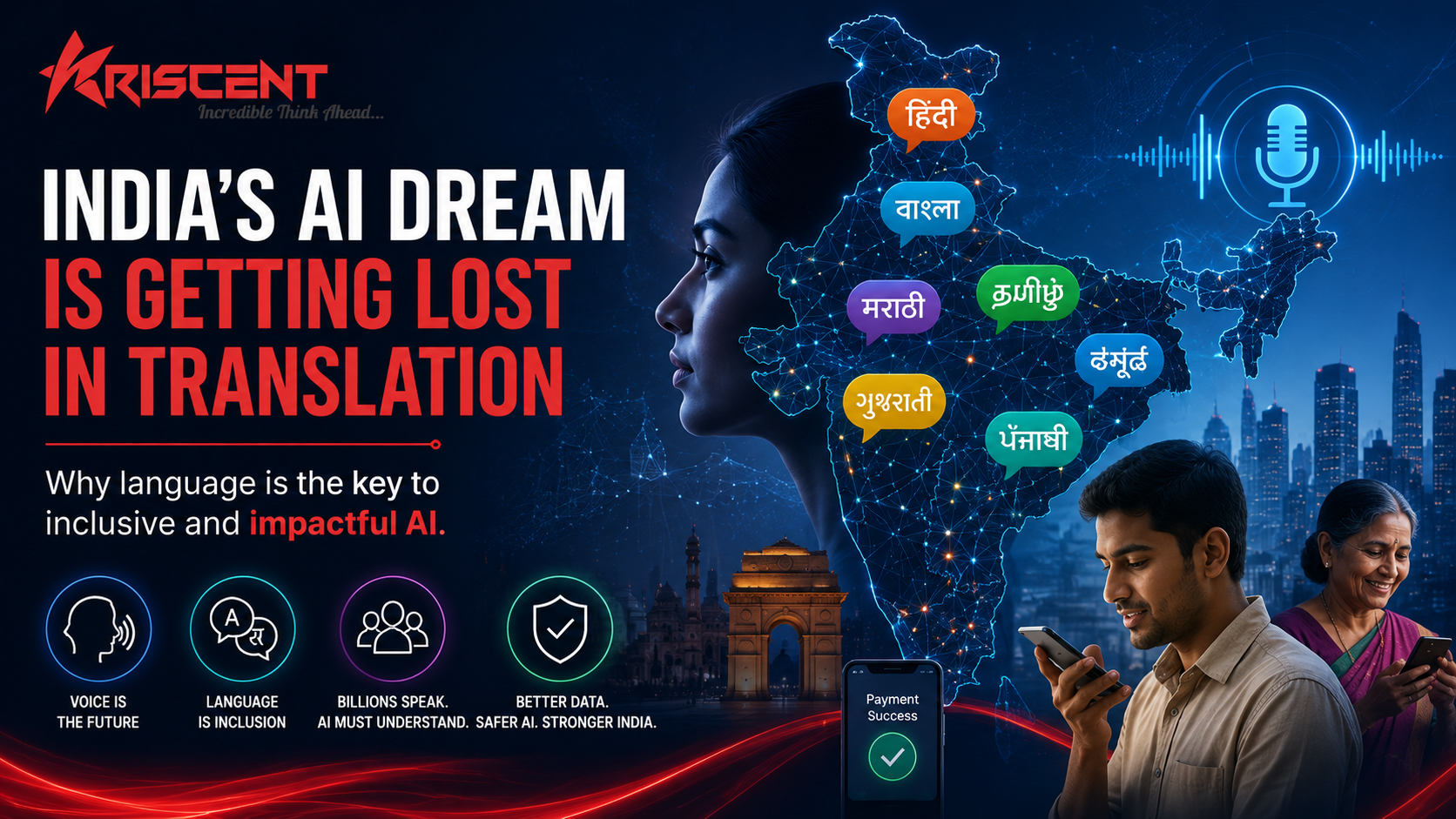
Artificial intelligence is rapidly becoming a part of everyday life, but for India, one major challenge could determine how successful the AI revolution truly becomes: language.
As India accelerates its journey toward becoming a global AI powerhouse, experts believe that multilingual intelligence, especially understanding regional languages and natural speech, will be the foundation of truly inclusive AI.
AI Cannot Be Inclusive Without Local Languages
India is home to more than a billion people who communicate in dozens of major languages and hundreds of regional dialects. While English dominates much of today’s AI training data, millions of Indians rely on Hindi, Bengali, Tamil, Telugu, Marathi, Gujarati, Punjabi, Malayalam, Kannada and many other languages for work, education, business and daily communication.
If AI systems fail to understand these languages naturally, they risk leaving a significant portion of the population behind.
The future of AI in India is not just about generating text. It is about understanding voice notes, local accents, mixed Hindi-English conversations, customer service calls, digital payments, healthcare discussions and government services.
Voice Is Becoming the Next AI Interface
Industry experts believe voice interactions will become one of the most important ways people use AI, particularly across developing economies like India.
From WhatsApp voice messages and phone-based customer support to speech-enabled banking and digital assistants, spoken language is increasingly replacing typed text.
However, building AI that understands India’s diverse speech patterns is far more complex than translating written content.
Regional accents, background noise, local slang, code-switching between English and regional languages, and varying pronunciations make speech recognition significantly more challenging than traditional language models.
Better Data Is More Important Than More Data
Developing accurate multilingual AI requires more than collecting massive amounts of information.
High-quality speech recordings, accurate transcriptions, human verification, demographic diversity and regional representation all play a critical role in improving AI performance.
Without carefully curated datasets, AI models may perform well in controlled environments but struggle during real-world conversations.
This makes ethical data collection and responsible AI development essential for India’s long-term AI ambitions.
Indian Companies Are Investing in Indigenous AI
Several Indian AI startups are already working to bridge this gap by building language models designed specifically for India’s linguistic diversity.
These efforts focus on improving speech recognition, document understanding and conversational AI across multiple Indian languages.
At the same time, global AI companies are expanding their research into Indian languages, while government initiatives continue supporting multilingual datasets and AI infrastructure.
The common goal is clear: create AI systems that work effectively for every Indian, regardless of the language they speak.
Language Is Also a Matter of AI Safety
Language barriers are not only an accessibility challenge but also a safety concern.
As AI becomes more common in healthcare, education, legal services and public administration, misunderstandings caused by poor language support could lead to incorrect information, biased outcomes or reduced trust in AI systems.
Ensuring AI understands local languages accurately is becoming just as important as making it intelligent.
India’s AI Opportunity
India possesses one of the world’s largest digital populations, a rapidly growing technology ecosystem and strong government support for artificial intelligence.
However, achieving inclusive AI will require more than advanced algorithms.
It will depend on building AI systems that genuinely understand how Indians communicate in everyday life.
The companies and countries that solve multilingual AI effectively will not only unlock enormous business opportunities but also ensure technology benefits millions of people who have traditionally remained outside the digital mainstream.
As AI adoption accelerates, language may prove to be the defining factor that determines whether India’s AI vision becomes a reality or remains an aspiration.






%20(1)%201.webp?updatedAt=1725274383969)