
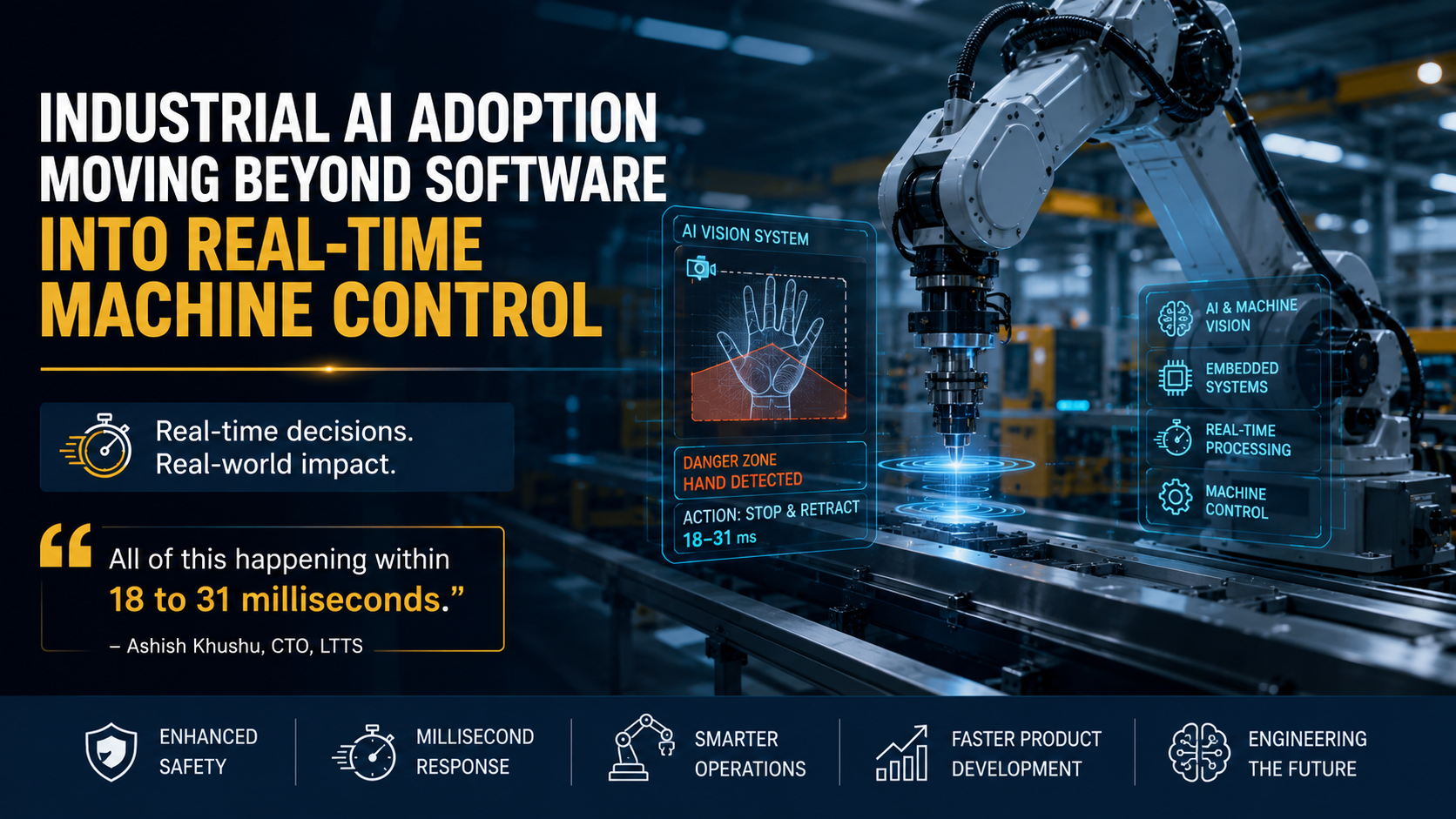
Artificial Intelligence is rapidly evolving beyond chatbots, automation tools, and software assistance into real-time industrial machine control systems, according to Ashish Khushu.
Speaking during the ninth edition of TECHgium, the engineering innovation platform organized by L&T Technology Services, Khushu highlighted how industrial AI is beginning to transform engineering environments where speed, precision, and real-time decision-making are critical.
The latest TECHgium edition recorded over 62,000 registrations from more than 540 engineering institutes across India, a 60% increase compared to the previous edition and nearly 800% growth since the platform’s launch in 2016.
Industrial AI Is Different From Traditional AI Software
According to Khushu, engineering-focused AI systems are fundamentally different from the software-centric AI tools dominating most enterprise discussions today.
While conventional AI applications often focus on productivity, automation, and content generation, industrial AI operates in environments where machines must interpret data and react instantly in the physical world.
These systems combine:
- Artificial Intelligence
- Computer vision
- Embedded systems
- Mechanical engineering
- Electrical instrumentation
- Real-time machine control
The goal is not simply to assist engineers, but to actively control and improve industrial operations with near-instant response times.
AI-Powered Safety Systems Already Being Used
Khushu shared an example involving an industrial wood-cutting machine designed for the US market.
The AI-driven safety system uses a camera mounted above the cutting blade to continuously monitor hand movement near the operational area.
If the operator’s hand enters a predefined danger zone:
- The camera captures the movement
- AI processes the image instantly
- The system sends a command to stop the machine
- The blade retracts automatically
Remarkably, the entire process happens within just 18 to 31 milliseconds.
According to Khushu, this demonstrates how industrial AI is now integrating multiple technologies simultaneously, including imaging systems, embedded chips, AI processing, electrical controls, and mechanical systems.
Real-Time AI Is Reshaping Engineering
The emergence of real-time industrial AI marks a significant shift in how AI is being applied across manufacturing and engineering sectors.
Unlike enterprise AI tools that assist users through software interfaces, industrial AI systems must operate in environments where:
- Timing is critical
- Physical safety is involved
- Machine precision matters
- Delays can cause operational failures
This is pushing engineering companies to rethink how AI integrates with industrial infrastructure and automation systems.
AI Is Accelerating Product Development
Beyond safety systems, Khushu also highlighted how engineering firms are using AI to reduce product development timelines and improve design quality.
One major area of impact is the early product development stage, particularly:
- Requirement gathering
- Product design specifications
- Engineering analysis
- Simulation processes
These are areas where AI can significantly reduce manual effort while improving accuracy and development speed.
Industry experts believe this could help companies shorten innovation cycles, lower production costs, and bring products to market faster.
Industrial AI Adoption Expected to Grow Rapidly
Although large-scale deployment of fully autonomous “agentic AI” systems in engineering remains in its early stages, adoption is steadily accelerating across manufacturing, industrial automation, robotics, and smart infrastructure sectors.
The convergence of AI, embedded systems, machine vision, and automation technologies is expected to redefine industrial operations over the coming decade. As businesses increasingly focus on Industry 4.0, smart manufacturing, and intelligent automation, industrial AI is moving from experimental innovation into real-world deployment.






%20(1)%201.webp?updatedAt=1725274383969)