
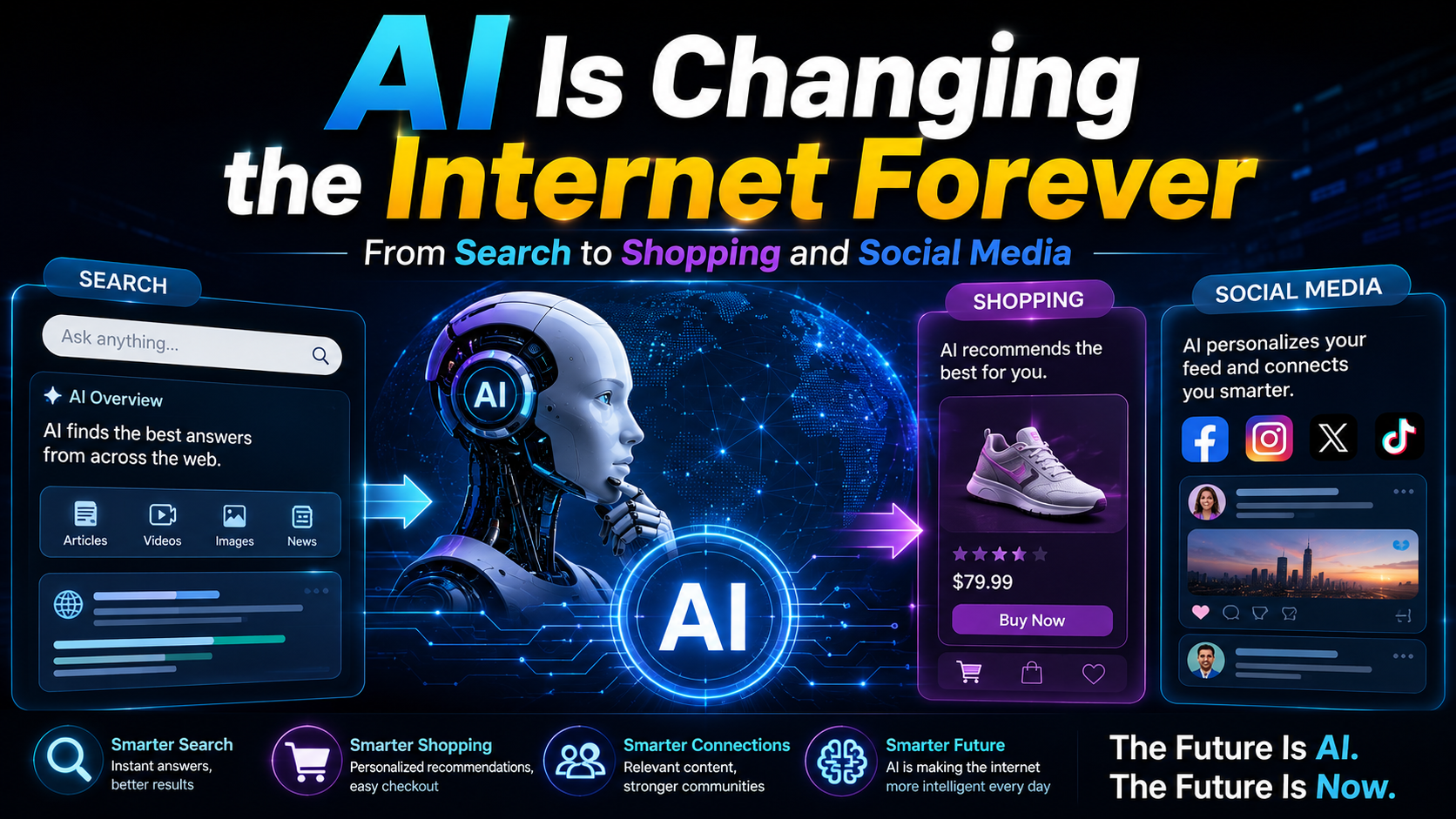
Artificial Intelligence is rapidly transforming how people use the internet, changing everything from online search and shopping to social media and digital marketing. Tech companies are redesigning their platforms around AI as users increasingly ask longer, more complex questions and expect faster, smarter, and more personalized responses.
According to Google, the internet is entering a completely new phase where traditional keyword-based search is evolving into conversational and AI-driven interactions.
Google Search Is Undergoing Its Biggest Transformation in 25 Years
Google recently announced major upgrades to its search engine aimed at adapting to changing user behavior.
Robby Stein, Vice President of Product for Google Search, explained that people are no longer searching with short keywords alone. Instead, users are asking detailed questions that often do not have a single clear answer available online.
To address this shift, Google is introducing AI-powered search experiences capable of generating:
- Custom visuals
- Interactive graphics
- AI-generated summaries
- Mini applications directly inside search results
The company is also redesigning its search interface to support:
- Longer text queries
- Image-based searches
- File uploads
- Contextual follow-up questions
This marks one of the biggest changes to Google Search since its launch.
People Are Searching More Like They Talk to AI
The growing popularity of AI tools like OpenAI’s ChatGPT is also changing user behavior online.
Experts say users are now typing searches in a more conversational way, similar to how they interact with AI chatbots.
Data from SEO platform Semrush shows:
- Searches containing 11 words or more are increasing rapidly
- Conversational queries have jumped significantly
- Traditional short keyword searches are declining
Google also revealed that:
- AI Mode searches are growing rapidly
- AI-driven searches are now three times longer than traditional searches
- Photo-based searches and visual search interactions are increasing by 60% year-over-year
This shift is forcing businesses, marketers, and websites to rethink how they create content and optimize for search engines.
AI Is Reshaping Social Media
AI’s influence is expanding far beyond search engines.
AI-generated influencers are now gaining massive popularity across platforms like Instagram, Meta, and other social media networks.
Virtual personalities such as:
- Aitana Lopez
- Lil Miquela
- Lu do Magalu
have attracted hundreds of thousands, and sometimes millions, of followers despite not being real people.
Brands are increasingly working with AI-generated creators because:
- They are cheaper than celebrity influencers
- They can be customized for campaigns
- They can operate continuously without human limitations
Marketing agencies report that spending on AI-generated creator content has grown significantly over the past year.
At the same time, companies like Meta and Google are integrating AI deeper into apps like:
- Gemini AI platforms
The goal is to make AI assistants a natural part of everyday online interactions.
AI Is Changing Online Shopping Too
Artificial Intelligence is also transforming eCommerce and digital shopping experiences.
Major companies including:
- Amazon
- Meta
- OpenAI
are introducing AI-powered shopping tools that help users:
- Compare products
- Analyze pricing
- Get recommendations
- Make purchasing decisions faster
Google recently introduced a universal AI shopping cart that allows users to add products from multiple retailers in one place.
Meanwhile, Amazon integrated its AI shopping assistant Rufus into Alexa-powered shopping experiences to help users compare products and pricing history using conversational AI.
According to recent industry data, traffic from AI services to retail websites has surged dramatically over the past year.
Websites and SEO Are Being Forced to Adapt
As AI-generated answers become more common inside search results, many websites are seeing noticeable changes in traffic patterns.
Industry experts report that many websites are receiving fewer clicks because users can now get summarized answers directly from AI powered search engines without visiting external pages. While overall organic traffic may decline for some businesses, the visitors who do arrive are often more qualified and have stronger purchase intent.
Businesses are reporting higher quality engagement from users who:
- Complete purchases
- Request quotes
- Book consultations or services
- Subscribe to newsletters
- Download resources
- Take direct action
This shift is changing the way brands approach SEO, content marketing, search engine optimization, AI SEO, performance marketing, conversion rate optimization (CRO), lead generation, and digital marketing strategies. Instead of chasing page views alone, businesses are focusing on creating authoritative, experience driven content that AI systems recognize as trustworthy.
Companies are also investing more in AI powered digital marketing, semantic SEO, voice search optimization, local SEO, technical SEO, content optimization, brand authority, and first party data strategies to remain competitive in AI driven search experiences. As traditional search evolves, partnering with a trusted digital marketing agency and adopting data driven marketing techniques will become increasingly important for maintaining online visibility and sustainable business growth.
The Internet Is Becoming AI-First
Industry experts believe AI will soon become deeply integrated into almost every online experience.
From search engines and shopping to social media and advertising, AI is no longer just an optional tool, it is becoming the foundation of how the modern internet operates. While concerns around jobs, misinformation, safety, and environmental impact continue to grow, businesses and users are rapidly adapting to an internet increasingly shaped by artificial intelligence.
The next version of the internet will likely be more conversational, visual, personalized, and AI-driven than ever before.


%20(1)%201.webp?updatedAt=1725274383969)