
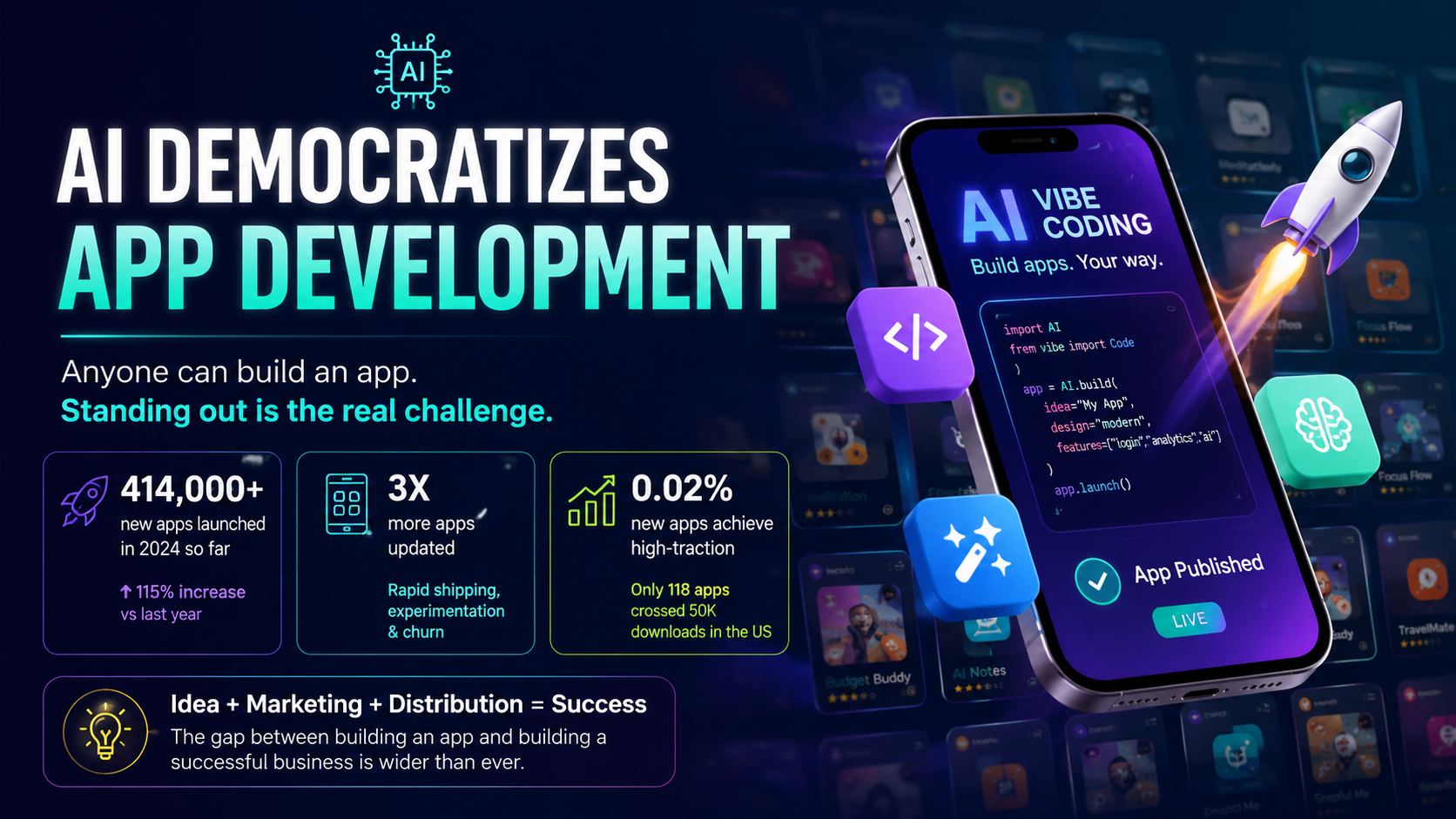
Artificial Intelligence is rapidly transforming the app development industry, making it possible for almost anyone to build and launch mobile applications without needing a full development team or months of coding experience.
The rise of AI-powered “vibe coding” tools is democratizing app creation, allowing solo creators, freelancers, and entrepreneurs to develop apps over a single weekend using AI-generated code, automation tools, and no-code workflows.
But while building apps has become easier, standing out in an overcrowded app marketplace is becoming significantly more difficult.
The App Store Gold Rush Is Back – With More Competition
According to data from Appfigures, more than 414,000 new Android and iOS apps have already been launched this year, marking a staggering 115% increase compared to the same period last year.
At the same time, app updates have nearly tripled, signaling an industry driven by rapid experimentation, fast launches, and constant iteration.
However, despite this explosion in app creation, only a tiny fraction of apps are gaining meaningful traction.
Reports show that just 118 newly launched apps managed to cross 50,000 downloads in the US market, a success rate of only 0.02%.
The numbers reveal a growing reality in the tech ecosystem: creating an app is no longer the hardest part. Building a profitable business around it is.
AI Has Lowered the Entry Barrier
Modern AI coding assistants and low-code development platforms are dramatically reducing technical barriers for first-time founders and independent developers.
Tasks that once required:
- Full-stack development teams
- UI/UX designers
- Backend engineers
- Months of testing and deployment
can now be partially automated using AI-powered workflows.
This shift is creating a new generation of “micro app entrepreneurs,” individuals building niche apps designed to generate side income rather than billion-dollar startups.
Industry experts expect the trend of AI-generated side-hustle apps to grow rapidly over the next few years.
Marketing Is Becoming More Important Than Coding
As thousands of new apps flood app stores every week, competition for visibility is intensifying.
Developers are now discovering that:
- User acquisition costs are rising
- App Store Optimization (ASO) is critical
- Branding matters more than ever
- Retention and engagement determine survival
In many cases, marketing strategy is becoming more valuable than the actual coding process itself.
This is especially relevant for startups and businesses planning to enter the mobile app market in 2026, where development speed alone will not guarantee success.
For companies evaluating budgets and long-term scalability, understanding the real investment behind app creation is becoming increasingly important. Businesses exploring app launches can also review detailed insights on Mobile App Development Cost in India in 2026 for Android & iOS to better understand pricing, development stages, and strategic planning requirements.
The Rise of the “Studio Model”
To improve their chances of success, many developers and app firms are adopting a “studio-based” strategy.
Instead of investing heavily into a single product, teams are now launching multiple versions of similar apps, such as:
- Fitness apps
- Meditation platforms
- Productivity tools
- AI utility apps
The goal is simple: release several products quickly and hope one or two gain significant traction.
Ariel Michaeli described the current market as a “higher-noise era” for app stores, driven by fast launches, aggressive experimentation, and fewer apps turning into sustainable businesses.
The Future of App Development
AI is undeniably reshaping software development by making app creation faster, cheaper, and more accessible. However, the industry is simultaneously entering an era where:
- Competition is harsher
- Attention spans are shorter
- User acquisition is expensive
- Distribution is increasingly difficult
The gap between building an app and building a successful company around it remains enormous.
Experts believe the next wave of successful app businesses will not necessarily be built by the best coders, but by founders who combine strong product ideas, distribution strategy, branding, and marketing execution effectively.
As AI continues to democratize development, app stores may see millions of new launches, but only a small percentage will evolve into sustainable businesses.






%20(1)%201.webp?updatedAt=1725274383969)