
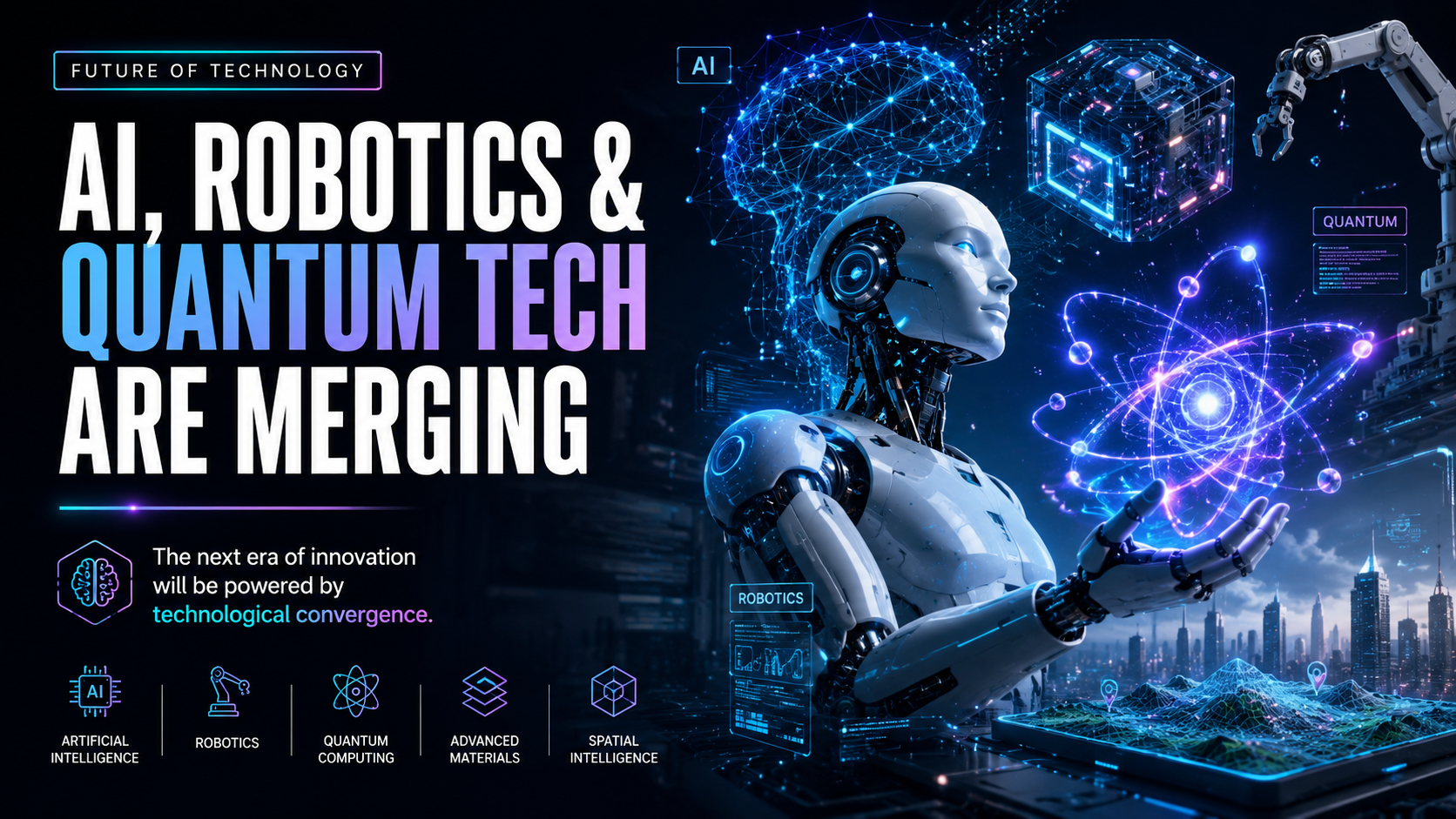
The next major wave of innovation will not be driven by a single technology alone. Instead, experts say the future belongs to “technological convergence,” the integration of multiple advanced technologies working together to solve complex real-world problems.
While Artificial Intelligence (AI) continues to dominate global conversations, industry leaders are now shifting attention toward a broader transformation where AI combines with robotics, quantum computing, advanced materials, spatial intelligence, and other emerging technologies to build smarter and more adaptive systems.
A recent report by the World Economic Forum and Capgemini highlights this growing convergence trend and its potential to reshape industries worldwide.
Eight Technologies Driving the Next Industrial Shift
According to the report, eight major technological domains are accelerating this transformation:
- Artificial Intelligence (AI)
- Robotics
- Omni Computing
- Engineering Biology
- Advanced Materials
- Spatial Intelligence
- Quantum Technology
- Next-Generation Energy Systems
Researchers believe the real breakthrough lies not in these technologies individually, but in how they interact and strengthen one another. This “combinatorial technology” approach allows organizations to create solutions that would be impossible through isolated innovations.
Healthcare Is Already Seeing the Impact
One of the strongest examples of this convergence is emerging in healthcare through cognitive robotic systems. Modern robotic-assisted medical systems now combine AI, robotics, spatial intelligence, advanced materials, and cloud computing to improve surgical precision and patient outcomes.
Advancements in robotics and material science have enabled the development of smaller, safer, and more accurate surgical instruments capable of operating in highly confined spaces.
At the same time, AI-powered spatial computing systems help doctors better understand surgical environments by delivering real-time guidance, predictive insights, and preoperative simulations.
Experts believe this combination could significantly transform future healthcare delivery.
Rise of Omni-Cloud Computing
The report also highlights the growing importance of omni-cloud computing, a distributed computing model designed to improve flexibility, scalability, and speed. Unlike traditional cloud systems that rely on a single provider, omni-cloud environments allow businesses to combine multiple cloud platforms based on their specific needs.
For example, a company may use Amazon cloud infrastructure for hosting websites while leveraging Microsoft Azure services for advanced analytics and data processing. This approach reduces latency and ensures applications remain closer to end users, creating faster and more responsive digital experiences.
Digital Twins Are Transforming Manufacturing
Another major development discussed in the report is the rise of digital twins in advanced manufacturing. Digital twins are real-time virtual replicas of physical systems, machines, or industrial operations. These systems continuously collect and analyze live data to optimize performance and predict failures before they occur.
With the integration of AI, digital twins are evolving beyond static monitoring tools into intelligent simulation environments capable of learning from real-world conditions.
Manufacturers can now test different operational scenarios, improve designs, reduce downtime, and make smarter decisions faster than ever before.
Smarter Renewable Energy Networks
Technological convergence is also reshaping energy infrastructure, especially in renewable power management. AI and omni computing technologies are helping energy providers optimize electricity flow and monitor grid performance in real time.
Meanwhile, spatial intelligence enables better placement of renewable assets such as solar panels and wind farms to maximize efficiency and system reliability.
Experts say future power grids will become highly adaptive networks capable of automatically responding to changing demand and environmental conditions.
Businesses Must Adapt Quickly
Industry analysts believe organizations that fail to adopt converged technology strategies could struggle to remain competitive in the coming years. As industries become increasingly interconnected, companies will need to build customized technology ecosystems that combine AI, automation, cloud infrastructure, intelligent analytics, and advanced computing into unified operational models.
The convergence era is no longer a futuristic concept, it is already reshaping healthcare, manufacturing, communication, and energy systems worldwide.




%20(1)%201.webp?updatedAt=1725274383969)