
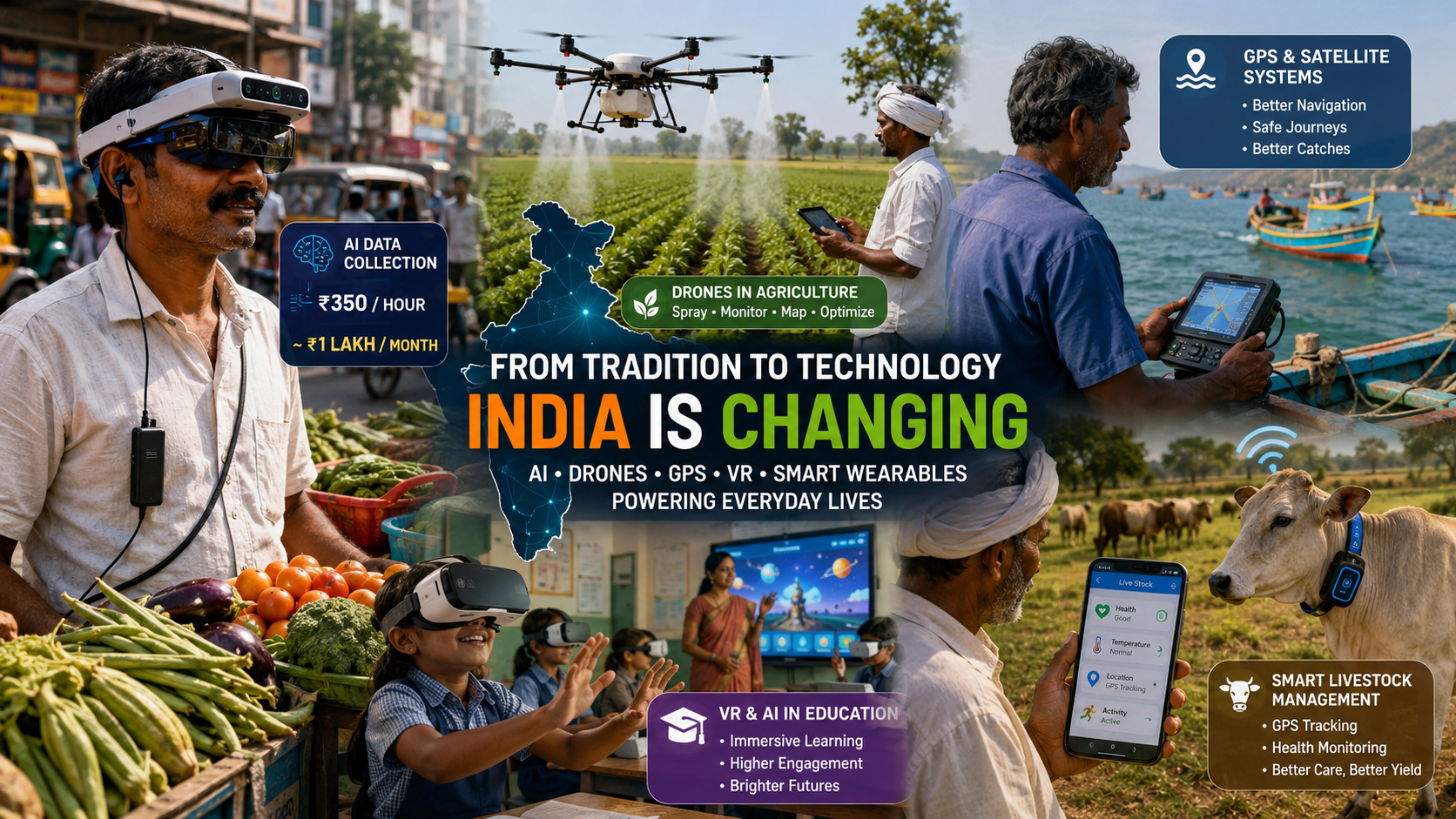
India’s digital transformation is no longer limited to corporate offices, startups, or big cities. Advanced technologies like Artificial Intelligence, drones, GPS systems, smart wearables, and Virtual Reality are now appearing in some of the country’s most unexpected places, from village classrooms to local markets and agricultural fields.
A recent viral moment from Bengaluru perfectly captured this changing reality.
Bengaluru Vegetable Vendor Wearing AI Gear Goes Viral
A street vegetable vendor in Bengaluru recently became an internet sensation after a video showed him selling vegetables while wearing a futuristic head-mounted device believed to be used for AI data collection.
The clip, shared widely on social media, claimed the vendor was earning around ₹350 per hour through the technology-related work, potentially adding up to nearly ₹1 lakh per month.
What fascinated viewers was the unusual contrast.
On one side stood a traditional vegetable cart, a familiar symbol of Indian street markets for decades. On the other was advanced wearable technology typically associated with Artificial Intelligence research and Silicon Valley innovation.
For many people online, it was one of the first times they had seen an ordinary local vendor directly connected to the growing AI economy.
Experts believe such wearable systems are often used to collect real-world visual data that helps train AI models to better understand:
- Human movement
- Shopping behavior
- Navigation patterns
- Crowded public environments
- Real-world interactions
The moment quickly became symbolic of how rapidly AI is blending into everyday life across India.
Drones Are Becoming Common on Indian Farms
Not very long ago, drones were mostly associated with filmmaking, defense technology, or high-end tech enthusiasts.
Today, they are increasingly becoming part of daily agricultural operations across India.
Farmers in states such as:
- Punjab
- Haryana
- Maharashtra
- Uttar Pradesh
- Andhra Pradesh
are now using agricultural drones to:
- Spray pesticides
- Monitor crop health
- Map agricultural land
- Analyze plant growth
- Improve farming efficiency
Government-backed initiatives promoting precision agriculture and “Drone Didi” programs are accelerating drone adoption in rural regions.
In some villages, drone operators are becoming as valuable as tractor drivers, highlighting how agriculture is rapidly evolving into a technology-driven industry.
Fishermen Are Using GPS and Satellite Systems
Technology is also reshaping traditional fishing communities.
For generations, Indian fishermen depended on instinct, weather patterns, stars, and years of experience to navigate open waters.
Today, many fishermen are using:
- GPS navigation systems
- Satellite-based weather tracking
- Digital marine communication tools
These technologies help:
- Identify better fishing zones
- Reduce fuel consumption
- Improve navigation accuracy
- Avoid dangerous weather conditions
- Increase safety during long sea journeys
In coastal regions such as Kerala, Tamil Nadu, Gujarat, and Andhra Pradesh, digital tools are improving both earnings and operational safety for fishing communities.
Rural Students Are Exploring the World Through VR
One of the most inspiring examples of India’s technology transformation is happening inside rural classrooms.
Virtual Reality (VR) and AI-powered learning systems are changing how children in villages experience education.
A standout example comes from Waddhamna village near Nagpur in Maharashtra, where what is being described as India’s first AI-powered Anganwadi has drawn national attention.
What was once a simple preschool with chalkboards and slates has evolved into a modern digital learning environment equipped with:
- VR headsets
- Smart boards
- Tablets
- AI-powered learning dashboards
- Interactive digital education content
According to reports, attendance has increased significantly as children now find learning more engaging and immersive.
The transformation demonstrates how technology can bridge educational gaps even in rural communities.
Smart Technology Is Helping Shepherds and Livestock Owners
Across many rural regions, livestock owners are also beginning to use smartphones, apps, and wearable technology to manage animals more efficiently.
Modern livestock management systems now include:
- GPS tracking
- Smart collars
- Health monitoring sensors
- Feeding and movement analytics
These wearable devices can track:
- Animal movement
- Body temperature
- Feeding habits
- Health conditions
For shepherds managing large herds across open land, GPS-enabled tracking helps reduce the risk of losing animals while improving overall herd management.
India’s Digital Revolution Is Reaching Everywhere
The most remarkable part of India’s technology transformation is not just the technology itself, but where it is appearing.
Artificial Intelligence, drones, VR, GPS systems, and smart wearables are no longer limited to urban technology hubs. They are quietly integrating into agriculture, education, fishing, livestock management, and local marketplaces across the country. The line between traditional livelihoods and futuristic technology is rapidly disappearing.
From a vegetable vendor wearing AI gear in Bengaluru to village students learning through VR headsets, India’s digital revolution is unfolding in ways few could have imagined just a few years ago.








%20(1)%201.webp?updatedAt=1725274383969)